
How to Start Small-Scale Goat Farming in India with ₹50,000
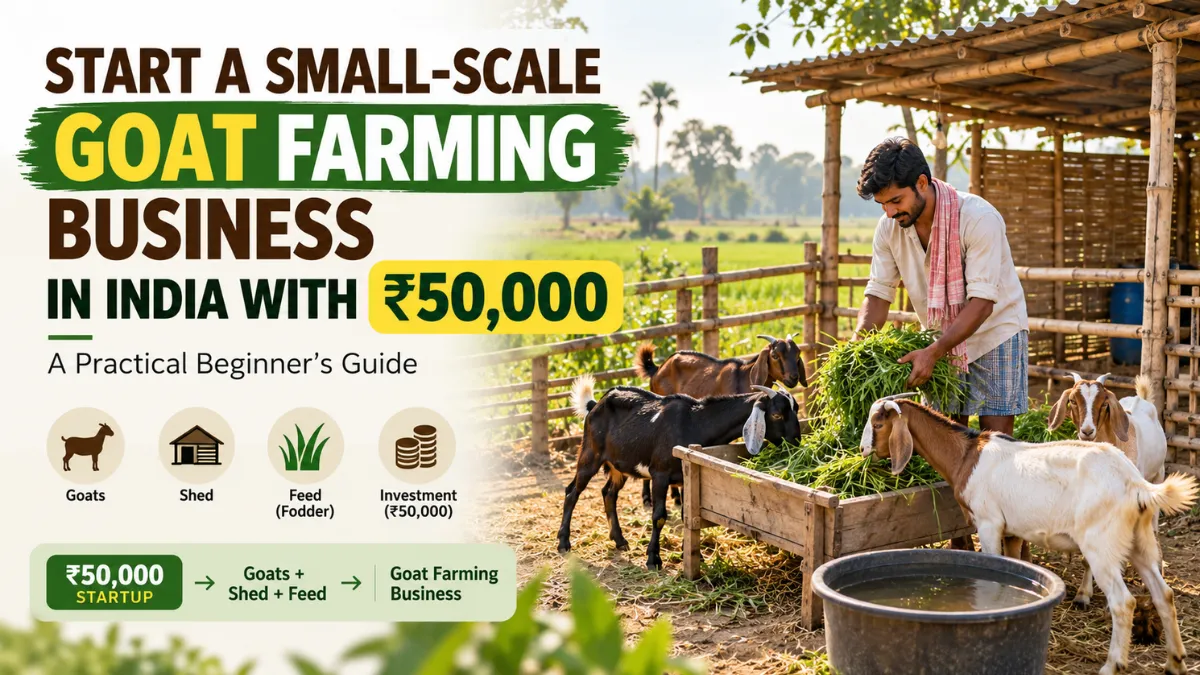
Starting goat farming with ₹50,000 is possible in some circumstances, but it is a small learning unit. It is not enough for a large commercial farm with rented land, a new permanent shed and a hired worker.
The plan works best when the family already has suitable space, can provide daily care and has dependable access to fodder. Local animal prices will decide how many goats the budget can support. Keep money for their care before deciding the herd size.
Check these conditions before purchasing goats
Visit nearby goat rearers and the local veterinary dispensary. Find out which animals perform well locally, which diseases are common and where healthy breeding stock can be obtained.
Also speak to at least two buyers. Ask whether they buy by live weight, age or visual assessment, what deductions they make and when they pay. A festival price quoted for an exceptional animal is not a dependable year-round selling price.
Check grazing permissions rather than assuming that roadsides, forest land or common land are freely available. Where all fodder must be purchased, prepare a fresh budget before investing.
A sample ₹50,000 starter budget
The following is an illustrative allocation for three locally suitable female goats. It is not a price survey. It assumes existing land, family labour and some access to home-grown fodder or permitted browsing.
| Expense | Assumed allocation |
|---|---|
| Three healthy female goats at ₹8,000 each | ₹24,000 |
| Repairs and basic improvement of existing shelter | ₹6,000 |
| Feeders, water containers and simple equipment | ₹2,000 |
| Initial feed and fodder reserve | ₹8,000 |
| Veterinary examination, transport and planned preventive care | ₹3,000 |
| Emergency cash reserve | ₹7,000 |
| Total | ₹50,000 |
If suitable females cost ₹11,000 each locally, this allocation no longer fits. Start with fewer animals or increase the budget. Do not buy unhealthy or very young animals simply to match the table.
The ₹8,000 feed allocation is an initial reserve, not a claim that it covers a full year. Insurance, breeding services and unexpected treatment may require additional money. Obtain quotations for them before purchase.
Choose suitability over a fashionable breed name
An animal already adapted to nearby farms can be a sensible first choice. Ask the KVK or veterinarian about locally suitable breeds and reliable sellers. Climate, feed supply, management and buyer preference all matter.
ICAR's goat training programmes emphasise housing, balanced feeding, breeding management and practical farm exposure. These are more useful to a beginner than buying a costly animal solely because its breed is popular online.
Have a veterinarian assess shortlisted animals. Check their age, body condition, movement, teeth, udder where relevant, and health and breeding history. A seller's claim of pregnancy should be verified appropriately.
For a very small herd, keeping a breeding buck can consume a large share of the budget. A reliable, disease-conscious breeding arrangement may be more practical. Avoid uncontrolled mating and keep parentage records to prevent inbreeding.
Prepare the shelter and feed plan first
The shelter should stay dry during rain, allow ventilation and protect goats from predators and theft. Arrange a separate space for new arrivals and sick animals. Ask the veterinarian for a quarantine period and health checks appropriate to the purchase source.
Use feeders that limit trampling and contamination. Plan feed for the dry season as well as the months when green material is abundant. Pregnant and lactating females and growing kids have different requirements.
An ICAR Indian Farming article explains why reducing feeding waste and matching nutrition to the animal's stage are central to goat management. Browsing alone should not be assumed to meet every animal's needs throughout the year.
Income is seasonal, while expenses continue
Goat rearing generally does not provide the steady daily sales of a milk business. Breeding, kidding and growth take time. Do not assume every female produces twins, every kid survives or all animals sell at a premium.
Maintain a notebook with purchases, mating dates, births, health costs, feed purchases and sale weights. Ask the veterinarian to prepare vaccination and parasite-control plans for the district. Routine guessing of medicine doses is neither economical nor dependable.
Consider this example only as a cash-flow exercise: four animals sold at ₹7,000 each bring ₹28,000 in sales. If the associated operating expenses are ₹18,000, the difference is ₹10,000 before family labour, depreciation, financing and other uncounted costs. This is not a forecast for three does or a promise of first-year income.
Animals retained on the farm have value, but that value is not cash available to pay bills. Keep business profit, sale receipts and herd value separate in your records.
Expand after learning from your own results
Before buying more goats, review kid survival, actual feed expense, sale prices and the time required each day. Expand only when the farm can feed and house the larger herd through a difficult season.
A ₹50,000 start is most useful as a way to build practical skills and test the local market without taking on an oversized unit.