
Low-Cost Cattle Feed Formulation Using Local Ingredients in India
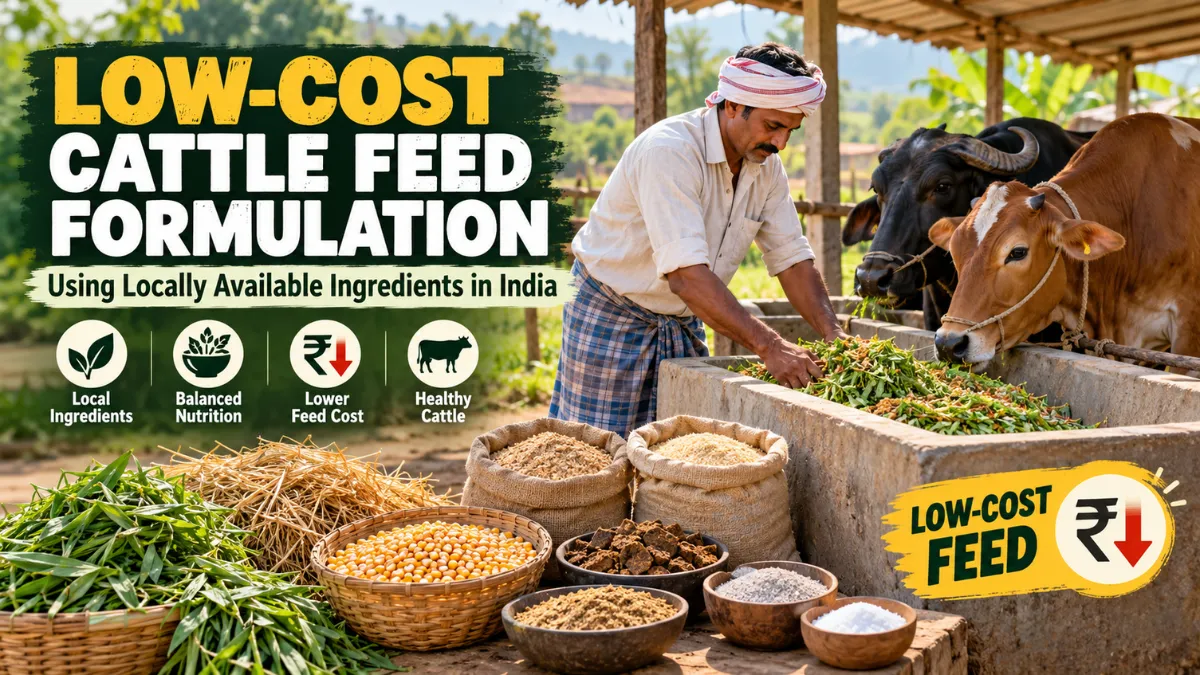
A cheaper bag of cattle feed does not always reduce the cost of producing milk. If the feed provides less usable nutrition, the cow may lose body condition or produce less milk. The useful target is a balanced ration at a reasonable cost.
Low-cost cattle feed formulation starts with three things: the animal's needs, the fodder already available on the farm and the quality of ingredients sold nearby. A mixture suitable for one dairy animal may be unsuitable for another.
Understand the difference between concentrate and a complete ration
Concentrate is the grain, bran, oil-cake and supplement portion of the diet. It is fed alongside suitable roughage and water. A 100 kg concentrate recipe is not 100 kg of complete daily feed, and it does not tell you how many kilograms an individual cow needs.
The National Dairy Development Board's Ration Balancing Programme considers animal type, production and the existing feeding pattern before recommending quantities of locally available ingredients. This is a better starting point than copying a neighbour's mixture.
Take the following details to a dairy cooperative's trained feeding adviser, veterinarian or animal nutritionist:
- Approximate body weight and body condition.
- Daily milk production and, if available, milk fat.
- Pregnancy status and stage of lactation.
- Daily quantities of green fodder, dry fodder and concentrate.
- Current ingredient prices and the quantities available through the year.
Which local ingredients can be considered?
| Ingredient group | Examples | What to check before buying |
|---|---|---|
| Energy ingredients | Maize and other suitable cereal grains | Moisture, mould, cleanliness and price |
| Protein ingredients | Feed-grade groundnut cake and processed soybean meal | Actual quality, adulteration and safe storage |
| Milling by-products | Wheat bran and suitable rice bran | Freshness, hull contamination and nutrient variation |
| Roughage | Suitable crop residues, cultivated grasses and legumes | Quality, seasonal availability and wastage |
| Supplements | Cattle mineral mixture and other prescribed ingredients | Product composition and the amount already in the ration |
“Locally available” does not mean that every agricultural by-product is suitable. Fertiliser-grade products, spoiled grain and unidentified oil cakes must not be added simply because they are cheap.
An Indian reference formula and how to use it
TNAU publishes a dairy concentrate mixture with the following base proportions. Converted to a 100 kg batch, they are:
| Ingredient | Quantity |
|---|---|
| Maize | 40 kg |
| Groundnut oil cake | 18 kg |
| Wheat bran | 36 kg |
| Feed-grade limestone powder | 3 kg |
| Mineral mixture | 1 kg |
| Common salt | 1.5 kg |
| Sodium bicarbonate | 0.5 kg |
| Base mixture total | 100 kg |
This is a published reference for discussion with a feeding adviser, not a universal recommendation. Its mineral, salt and buffer levels need checking against your fodder, water, existing feed and supplement composition. TNAU also lists additional products separately; do not assume every additive is necessary for your herd.
Do not replace groundnut cake with another cake kilogram for kilogram without reformulation. Protein, fibre, energy and safe inclusion levels differ. This mixture is also not a calf milk replacer or a substitute for a calf-specific feeding programme.
Calculate the actual cost of a batch
Use this formula:
Batch cost = total ingredient cost + grinding + mixing + transport + handling losses.
For a simple arithmetic example, suppose the ingredients for 100 kg cost ₹2,700 and processing and transport cost ₹200. The batch costs ₹2,900, or ₹29 per kg before storage losses. These are assumed figures, not current market prices.
If a nutritionally suitable purchased feed costs ₹31 per kg delivered, the difference is ₹2 per kg. Whether home mixing is worthwhile depends on reliable ingredient quality, labour, storage and the quantity used. A tiny saving can disappear if a batch spoils.
Also compare feeds on a consistent basis. A kilogram of wet material cannot be compared directly with a kilogram of dry feed. Ask the adviser to consider dry matter and usable nutrients.
Reduce waste before cutting nutrition
Store ingredients in a dry, ventilated place, protected from rain and rodents. Buy quantities that can be used while fresh. Reject mouldy or foul-smelling material; mixing it with clean feed does not make it safe.
Use weighed quantities and suitable mixing equipment so supplements are distributed evenly. Construction limestone is not an acceptable substitute for feed-grade material. Do not add loose urea to a home mixture without a professionally designed programme and trained supervision.
NDDB recommends gradual feed changes and using suitable chopped fodder to reduce waste. Maintain clean drinking water and follow the animal-specific ration rather than increasing grain whenever milk falls.
Record feed expense, milk sold, body condition and feed refusals. Compare similar stages of lactation. A fall in milk can also reflect heat, disease or advancing lactation, so feed cost alone cannot explain the result.