
How Contract Farming Works in India and What to Check Before Signing
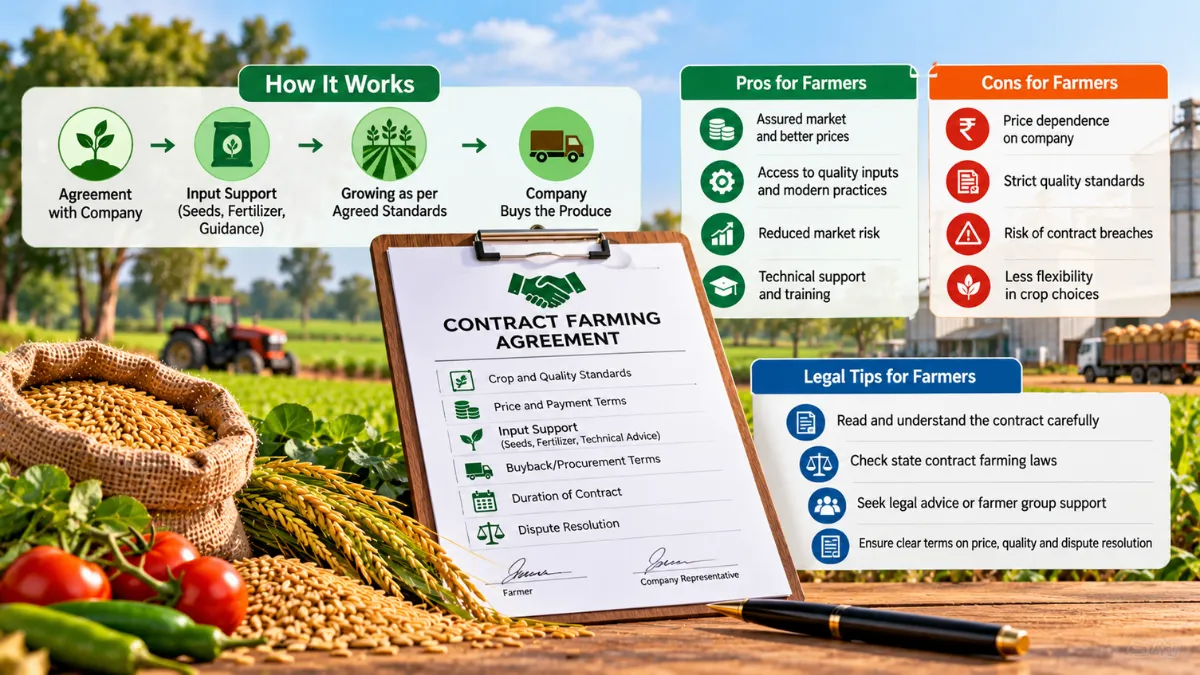
Contract farming is an arrangement in which a farmer and a buyer agree on production or supply conditions before the sale. The agreement may specify the crop, variety, quality, quantity, price and delivery date. Some buyers also provide seed, inputs or technical support.
For a farmer, the attraction is a clearer market for the crop. The risk is that an attractive quoted price may be reduced by rejection, deductions or delayed payment. A useful agreement must explain both sides of the deal in language the farmer understands.
How an arrangement usually works
A buyer discusses its requirements with an individual farmer or an FPO. The parties agree on the area or quantity, production conditions and purchase terms. The crop is grown, inspected or graded, delivered and paid for under those terms.
These stages should be written down. A field officer saying “the company will buy everything” is not enough if the signed document allows the buyer to reject produce without an objective test.
Keep a signed copy before buying special inputs or committing land to a variety intended mainly for that buyer.
The current legal position needs care
The Farm Laws Repeal Act, 2021 repealed the central Farmers (Empowerment and Protection) Agreement on Price Assurance and Farm Services Act, 2020. Its special procedures should therefore not be presented as the current nationwide contract-farming framework.
The Indian Contract Act, 1872 remains relevant to general contract principles. State agricultural-marketing laws and other applicable laws may also affect an arrangement. Registration, market requirements and the correct dispute forum need to be checked for the state and contract involved.
This is a general explanation, not a legal opinion on a particular agreement. Have a local lawyer familiar with agricultural transactions review the document before signing, especially where large input advances, security or penalties are involved.
Benefits and risks to compare
| Possible benefit | Related risk to examine |
|---|---|
| An identified buyer before harvest | Buyer may delay lifting or reject the crop |
| Agreed price or pricing formula | Farmer may miss a higher market price |
| Access to specified seed and advice | Input costs may be deducted later |
| Clearer quality target | Grading may be controlled entirely by the buyer |
| Aggregated sales through an FPO | Individual obligations and deductions may be unclear |
The benefit depends on performance of the agreement. A purchase commitment is only as useful as its terms and the buyer’s ability to honour it.
Write the price formula clearly
The agreement should state whether the price is fixed, linked to a named market or based on grades. If market-linked, identify the market, date range, grade and method used to calculate the reference price.
For illustration, a ₹12-per-kg offer on 10,000 kg appears to produce ₹1,20,000. If only 8,000 kg is accepted and ₹15,000 is deducted for agreed inputs, the payment for the accepted crop is ₹81,000. Any value recovered from rejected produce is separate.
These example figures are not current contract rates. They show why the acceptance rule and deductions matter alongside the headline price.
Eight clauses farmers should examine
- Buyer identity: Legal name, address and authority of the person signing.
- Crop and quantity: Variety, area, expected quantity and permitted variation.
- Quality: Measurable standards, sampling method and independent re-testing option.
- Price: Grade-wise rate, floor if agreed, and any market-linked formula.
- Inputs: Ownership, quality responsibility, cost and recovery terms.
- Delivery: Collection point, weighing, transport and responsibility for delay.
- Payment: Due date, payment method, permitted deductions and proof of acceptance.
- Disputes and exit: Notice, escalation, termination and the legally appropriate forum.
Ask what happens if there is crop failure, seed failure, a transport interruption or a buyer cancellation. A general reference to “unavoidable circumstances” can leave major questions unanswered.
Protect your control over land and documents
Read any clause involving a lease, mortgage, charge, guarantee or power of attorney separately. A crop-supply discussion should not distract you from a document that affects land rights or creates wider financial liability.
Do not sign blank pages or allow later changes without a signed record. Keep originals securely and share copies only where needed. If the agreement is in English, obtain an explanation or translation you can understand before signing.
Do not assume an unenforceable or unfair-looking clause can simply be ignored later. Get it corrected before committing to the arrangement.
What to do at harvest and delivery
Record collection dates, accepted and rejected quantities, weighment and grading results. Obtain a receipt naming the crop lot and buyer. If a quality dispute arises, request the agreed test and preserve samples through a documented method where appropriate.
If payment is delayed, send a dated written demand with the invoice or receipt. Preserve messages and approach the agreed grievance channel and appropriate legal adviser. The right forum depends on the governing law and agreement; it is not automatically the same for every state.