
How Drip and Sprinkler Irrigation Can Improve Farm Income
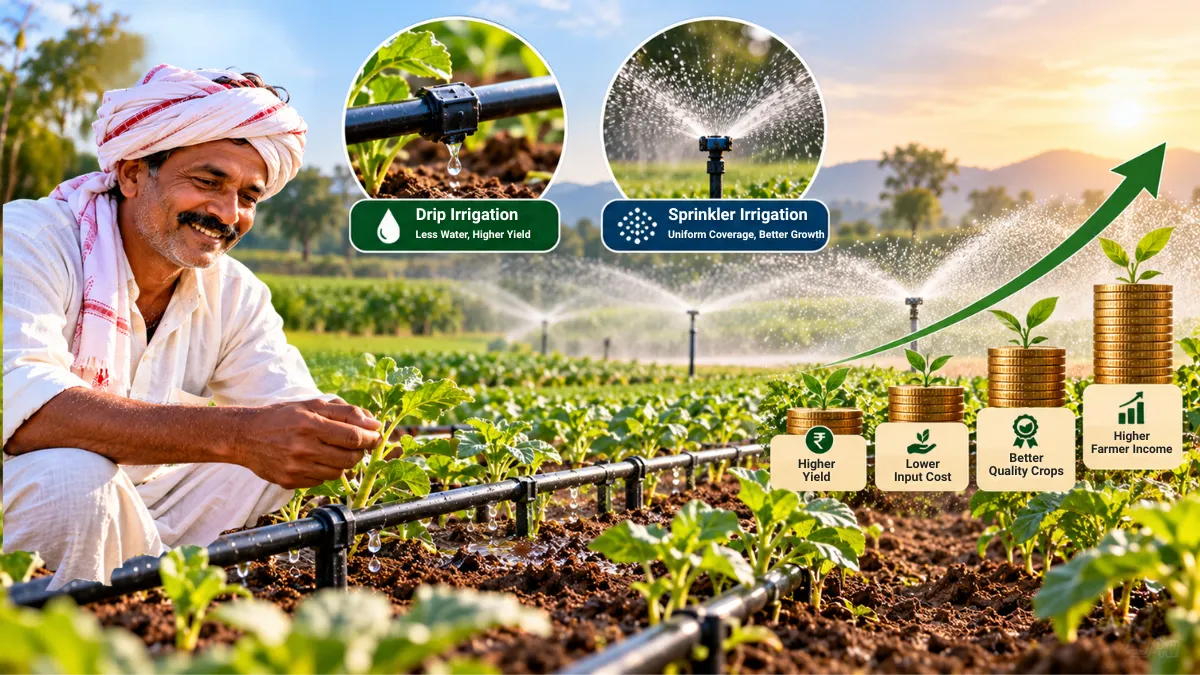
Micro-irrigation can improve farm income when it solves a real water-management problem. Better control over irrigation may reduce avoidable losses, improve crop uniformity and save labour. But installing pipes does not automatically double a farmer’s income.
The result depends on crop choice, water quality, system design, maintenance and the price received for produce. A system that performs well in an orchard may not be the right investment for a different crop or a field with an unreliable water source.
How drip and sprinkler systems differ
Drip applies water through emitters near the root zone. Sprinklers distribute water through nozzles over a wider area. Both need a design suited to the crop, soil and available pressure.
| Point | Drip irrigation | Sprinkler irrigation |
|---|---|---|
| Water delivery | Localised application through emitters | Water sprayed over the cropped area |
| Typical consideration | Row spacing, root zone and emitter placement | Nozzle spacing, pressure and coverage |
| Common uses | Orchards and many row crops | Many closely spaced field crops |
| Main checks | Filtration, clogging and uniform discharge | Wind, overlap and pressure uniformity |
| Day-to-day work | Inspect emitters and flush as specified | Inspect nozzles, leaks and distribution |
These are starting points for comparison, not a universal crop recommendation. Some crops can use either approach when properly designed.
Where the additional income can come from
Income can improve through a combination of savings and saleable output. A farmer may spend fewer hours managing irrigation, use water more precisely or produce a more uniform crop. In suitable systems, fertigation also allows nutrients to be applied through irrigation under a crop-specific plan.
However, pumping costs will not necessarily fall. A pressurised system may need a different pump or operating schedule. Calculate electricity or diesel use for the proposed design rather than assuming every saving reported elsewhere will occur on your farm.
Higher production also helps only when the extra crop can be sold at a worthwhile price. Harvesting, packing and transport expenses may rise with output.
What Indian evidence shows
A PIB review published in August 2026 reports that a NITI Aayog evaluation during 2020–21 found income gains ranging from 10% to 69% in the scheme assessment. The range itself shows that results vary; it is not a forecast for a new installation.
Use such evidence to understand the potential, then examine local farms with similar crops and conditions. Ask farmers what they spent on repairs, how the system performed in peak summer and whether saleable yield improved over more than one season.
A simple example of the income calculation
The following figures are assumptions for explaining the calculation, not a quotation or field-study result.
| Annual item | Before installation | After installation |
|---|---|---|
| Crop sales | ₹1,20,000 | ₹1,35,000 |
| Recurring cultivation and selling costs | ₹80,000 | ₹78,000 |
| Annual system cost allowance | ₹0 | ₹8,000 |
| Net return on this simplified basis | ₹40,000 | ₹49,000 |
The improvement is ₹9,000, or 22.5%. It is useful, but it is not a doubling of income. Keep land rent, family labour and other costs on the same basis in both columns. Include interest and replacement costs where applicable.
If calculating simple cash payback separately, divide the actual cash investment by additional annual cash surplus. Do not deduct the purchase cost twice by also treating full depreciation as a cash payment in that calculation.
Check these points before buying
Ask the supplier to inspect the field and water source. Obtain a written layout showing the pump requirement, filtration, valves, pipe sizes, operating zones and intended pressure.
Have the water checked for conditions that could affect performance. Tamil Nadu Agricultural University’s guidance identifies sediment, organic material and salts among causes of emitter clogging. Filters and maintenance are essential parts of the installation.
Compare quotations on the same specification. A cheaper package may leave out filters, fittings, installation or after-sales support. Ask who will fix uneven discharge and how quickly replacement parts can reach the village.
What subsidy support is available?
The government’s Per Drop More Crop guidance describes assistance of 55% for small and marginal farmers and 45% for other farmers, subject to scheme norms. State support may differ or add to the central pattern.
Confirm the eligible cost, area limit, approved supplier process and required sanction before ordering. A percentage in a national scheme description does not mean that percentage of every dealer’s quotation will be reimbursed.
After installation, measure performance
Check whether plants near the far end receive adequate water. Record operating hours, rainfall, maintenance and crop performance. Adjust scheduling with technical advice as the crop grows rather than running the system for the same duration throughout the season.
Clean filters and flush lines according to the system instructions. Get trained help for chemical cleaning; guessing a concentration can damage equipment or create a handling risk.