How to Start Organic Farming with a Practical Three-Year Roadmap
Moving to organic farming involves more than replacing a fertiliser bag with manure. The farm still needs enough nutrients, timely weed management, protection from pests and a buyer willing to purchase the crop on clear terms.
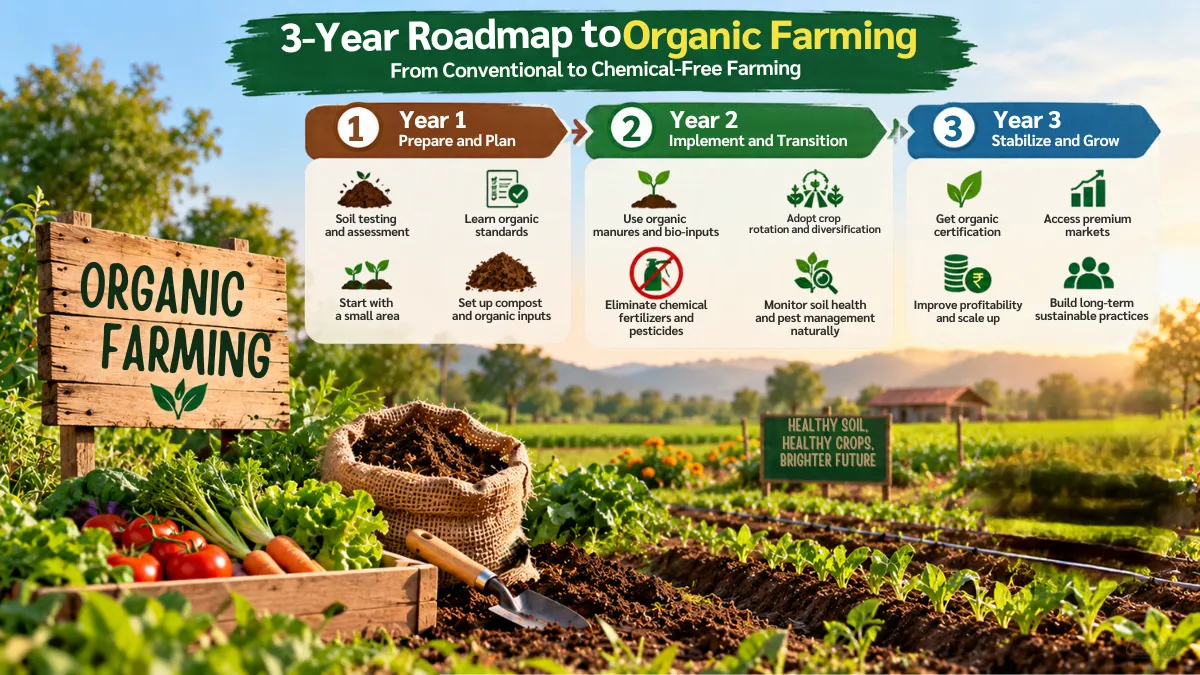
A three-year plan gives a beginner time to learn and review costs before expanding. It is a management roadmap, not a promise that every farm will receive organic certification exactly three years after starting.
First understand the conversion period
Under NPOP’s eighth-edition standards, annual and biennial crops generally require at least two years of compliant organic management before sowing the crop to be certified organic. Perennial crops generally require at least three years before the first organic harvest. Recognition of earlier management and any permitted adjustment require assessment under the standard.
Ask the certification body to confirm the recognised start date and the first eligible crop. Stopping a prohibited input today does not automatically establish an accepted certification history.
FSSAI recognises NPOP and PGS-India certification systems for organic foods. Their procedures differ. Choose the route that suits the intended market and confirm the applicable production, certification and labelling requirements before printing packaging.
Before year one — check resources and buyers
Make a field map and record the previous crops and inputs. Test the soil and list the organic materials realistically available nearby. Include the cost of collecting, transporting, preparing and applying those materials.
Speak to potential buyers about crops, quantities, grades and certification. Ask whether they buy produce during conversion and at what price. Use ordinary market prices in your budget unless a dependable buyer has agreed otherwise.
If converting only part of a farm, confirm the rules for split production and separation before starting. A small trial is useful, but its design must not create a certification problem.
Year one — establish a workable system
Choose a manageable plot and a crop you already understand. Plan how to supply nutrients and manage weeds before sowing. Removing conventional inputs without a replacement management plan can leave the crop short of nutrients or labour.
ICAR guidance on organic cropping emphasises rotation, organic nutrient sources, biofertilisers and timely management of weeds, pests and diseases. Work with the local KVK to adapt those principles to your soil, rainfall and crop.
Do not assume every product sold as “bio”, “natural” or “organic” is permitted. Check its composition, intended use and acceptance under your certification system before buying or applying it.
Keep a field diary from the first day:
| Record | What to note |
|---|---|
| Field history | Plot identity, previous crop and previous inputs |
| Seed | Variety, source, invoice and treatment information |
| Inputs | Product or material, source, quantity and date |
| Field operations | Sowing, irrigation, weeding and crop protection |
| Harvest | Date, plot, weight and lot identity |
| Sales | Buyer, quantity, price and payment received |
At the end of the season, calculate saleable yield and costs, including family labour on a consistent basis. A lower purchased-input bill may be offset by extra labour or transport.
Year two — correct the weak points
Use the first year’s records to identify the main limitation. Was it a nutrient shortage, weed growth, poor establishment or the lack of a buyer? Correct the actual problem instead of adding more products without a diagnosis.
Plan crop rotation around local agronomy and market demand. Legumes, cover crops and recycling of suitable residues can contribute to the system, but they do not automatically supply every nutrient removed in harvest.
Check the availability and quality of compost or manure before expanding. Organic materials vary in nutrient content and release rate. A fixed number of trolley loads is not a complete nutrient budget.
Develop preventive crop protection through suitable varieties, field sanitation, monitoring and appropriate cultural or biological measures. Serious problems still need timely expert advice. “Organic” should not mean leaving a crop untreated until losses become unavoidable.
Year three — review certification readiness and the business
Check whether the crop and land meet the applicable conversion requirements. Complete inspections or peer-review steps required by your chosen system, resolve any non-compliance and obtain the relevant approval before making certified-organic claims.
Review storage and transport as carefully as cultivation. Separate lots, identify bags and record movements so a buyer can trace produce back to its field. Prevent mixing with conventional or in-conversion produce.
Then decide whether to expand. Compare at least the following on a consistent basis:
- Saleable output and the price actually received.
- Labour, compost, transport and crop-protection expenses.
- Inspection, certification, packing and marketing costs.
- Rejection or unsold produce.
- Cash needed for the next season.
A premium is useful only if it survives these costs and reaches the farmer through actual payment.
What Indian experience can teach beginners
An ICAR publication on integrated organic farming in the hill ecosystem of Northeast India describes the value of linking crop and livestock activities and maintaining nutrient balance. It provides a useful example of farm-level planning, but the model should not be copied directly into a dryland farm in Madhya Pradesh.
Choose locally suitable practices and verify the business case on your own records. Expansion should follow reliable production and sales, rather than a fixed calendar target.