
PMFBY Crop Insurance Claim Process and Reasons Claims May Fail
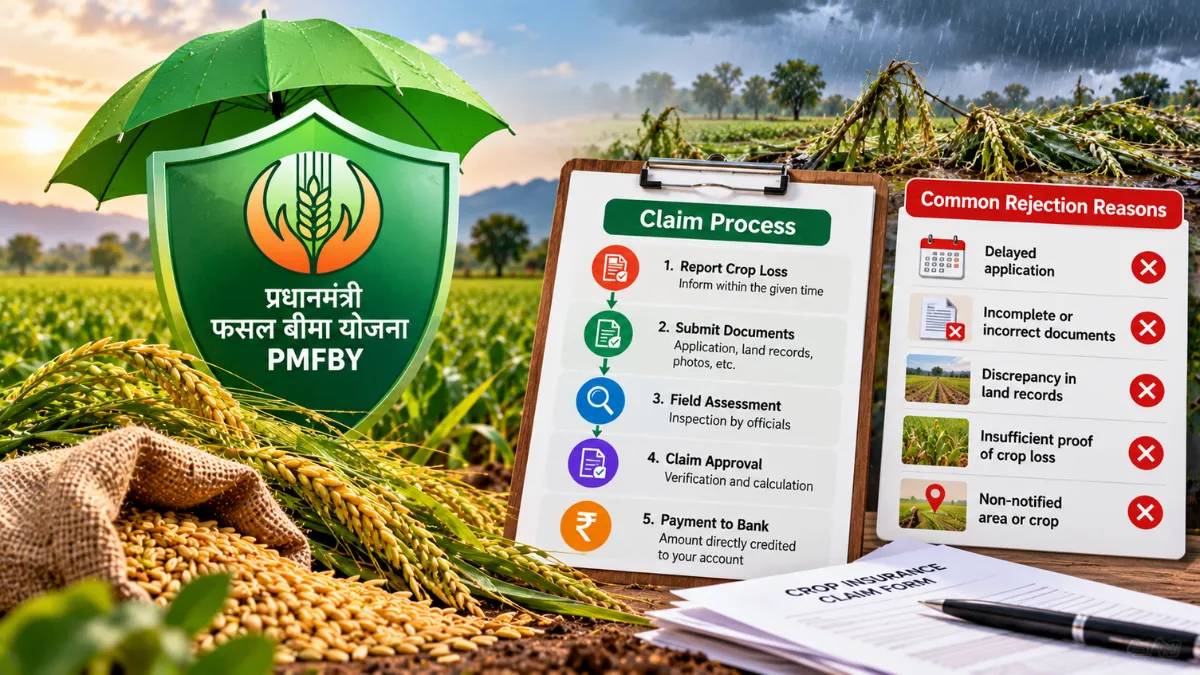
After crop damage, the first task is to confirm your insurance details and report the loss through the appropriate channel. Waiting for a neighbour’s payment or a village-wide survey can create problems when your claim category requires an individual loss report.
Under Pradhan Mantri Fasal Bima Yojana, coverage depends on the notified crop, location, season and insured risk. A premium debit or a general announcement does not, by itself, explain which loss category applies to your field.
First check your insurance record
Keep the application or policy number, premium receipt, crop name, insured area and insurer details ready. Check the survey or khasra number and season against your actual cultivation.
If the record contains the wrong crop or area, raise the issue immediately with the enrolment channel and insurer. Do not assume it will be corrected automatically when a claim is assessed.
Tenant farmers and sharecroppers can be eligible subject to prescribed requirements. The documents accepted for cultivation or insurable interest depend on the state’s notified process.
Understand the main claim routes
| Loss category | How the assessment generally works |
|---|---|
| Widespread standing-crop yield loss | Uses the notified insurance unit and the applicable yield-assessment process |
| Covered localised calamity | Individual affected-farm assessment, with loss intimation required |
| Covered post-harvest loss | Assessment subject to the specified crop condition, peril and time window |
| Prevented sowing or mid-season adversity | Depends on scheme conditions and the relevant notification or assessment |
Do not treat every damaged field as an individual yield-loss claim. Under the area-based route, a farmer’s own lower harvest does not necessarily produce a payable claim if the insurance-unit conditions do not trigger payment.
Report localised and post-harvest losses within 72 hours
For these categories, report the loss within 72 hours of the loss event through an accepted channel. SBI General’s PMFBY claims guidance lists the Krishi Rakshak helpline 14447, the concerned bank, agriculture department, district officials and the government crop-insurance application among the reporting routes.
Use your assigned insurer’s details and the current state instructions. Obtain a complaint or intimation number and retain the submission time. If the app fails, try another accepted channel promptly and preserve evidence of the failed attempt.
Do not postpone the first report while waiting to collect every supporting document. Ask what further information must be submitted and by when.
What to record when reporting damage
Prepare a short, factual description with:
- Farmer name, registered mobile number and application or policy number.
- Village, field identification and insured crop.
- Event date, approximate time and type of damage.
- Affected area and crop stage.
- Harvest date, if claiming eligible post-harvest loss.
- Photographs and location information where requested.
Take wide photographs showing the field and closer photographs of damage, when safe. Keep original files and avoid editing away date or location information. Photographs support assessment; they do not independently guarantee payment.
Post-harvest cover has limits
The government’s August 2026 explanation describes cover for specified events affecting crops kept in cut-and-spread condition in the field for up to 14 days after harvest. This should not be understood as insurance for all stored produce or every loss after cutting.
The crop, event and add-on coverage notified for your season still matter. Verify the applicable conditions before assuming that rain damage in a shed, transport loss or a later storage problem is covered.
Reasons a claim may be rejected, reduced or remain unpaid
These are practical issues to check, not a ranked national list of rejection statistics.
| Issue | What to check |
|---|---|
| No valid cover for the crop, area or season | Policy record and seasonal notification |
| Late intimation where individual reporting is required | Reporting deadline and acknowledgement timestamp |
| Recorded crop or field differs from actual cultivation | Enrolment documents and correction history |
| Event is outside the insured risks or period | Relevant coverage clause |
| Loss assessment does not establish a payable amount | Assessment findings and calculation basis |
| Bank or beneficiary details prevent payment | Payment status and account validation |
| Claim processing is incomplete | Exact pending stage and responsible office |
A bank-account problem may delay payment without being a rejection of the underlying claim. Similarly, a pending assessment should not be reported as a final denial.
How to follow up or challenge a decision
Ask for the written reason and claim status. Submit a short representation identifying the disputed detail and attach copies of the policy, loss intimation and relevant evidence.
Use the insurer’s grievance process and the Krishi Rakshak Portal and Helpline at 14447. Ask the local agriculture office about the district or state grievance route applicable to the case. Keep every reference number in one place.
Do not rely on a verbal promise of a fixed settlement date. Ask which stage remains pending and whether any action is required from you. Where a bank or intermediary may have made an enrolment error, preserve payment and application records rather than assuming the problem was your fault.