
Potato Cold Storage in India: Temperature, Rent Cost and Subsidy
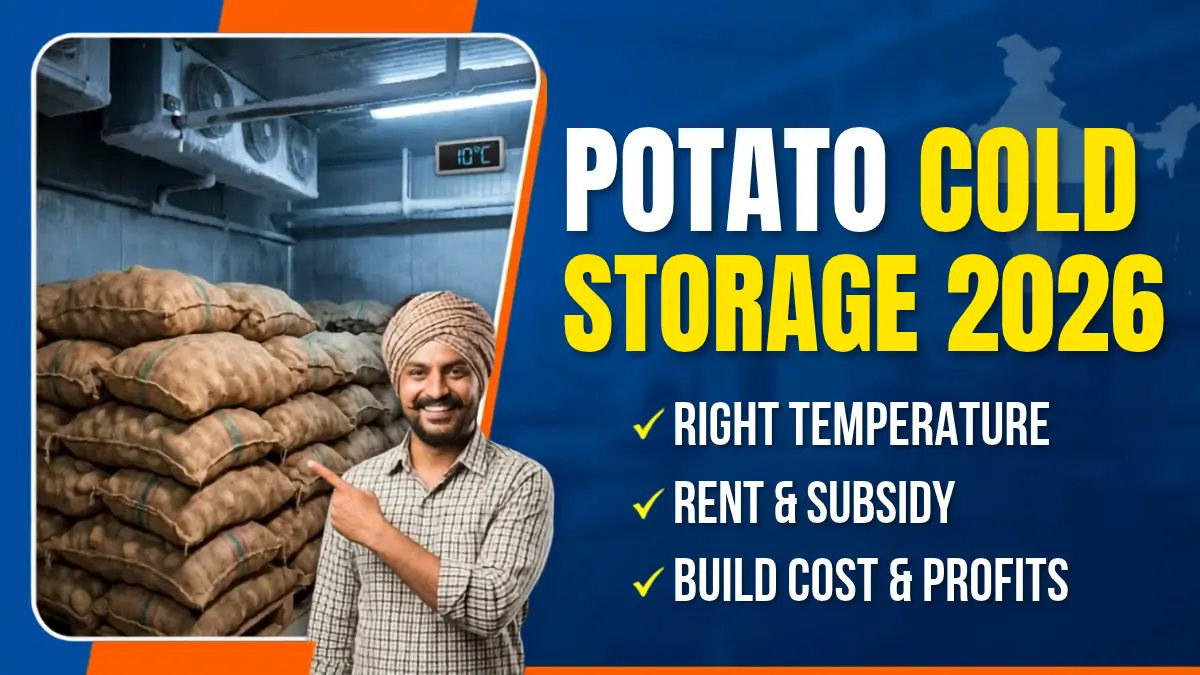
India has roughly 5,000 cold stores. Around 80% of that capacity holds one crop: potato. Yet ICAR-CPRI still puts post-harvest potato losses near 16%.
That gap is not a technology problem. It is an information problem. Most farmers never learn what temperature their crop needs, what the rent should be, or what the government will pay them back.
I will tell you that. You will learn the correct storage temperature for your potato type, the rent you should be paying in 2026, how to claim the ₹100 per quintal subsidy, and what it costs to build your own unit.
What Potato Cold Storage Actually Does
A potato is alive after harvest. It breathes, loses water, and tries to sprout.
Cold storage slows all three down. Lower the temperature and the potato enters a sleep mode. Sprouting stops. Rotting slows. Weight loss drops.
In north India, farmers simply call it aloo cold storage. Most units run on ammonia refrigeration with bags stacked on multiple floors.
The split across the country is roughly 60% table potato and 40% seed potato. These two need very different handling, which brings us to the biggest mistake in the business.
The Right Temperature for Potato Cold Storage
At 2–4°C, a potato converts its starch into sugar. This is called sweetening. The potato turns sweet, and chips made from it fry black. For seed potato this does not matter. For eating and processing, it ruins the crop.
ICAR-CPRI recommends a different line for table and processing potato: 10–12°C with a sprout suppressant. CIPC was registered in India in 1998 and is now used in around 450 cold stores for exactly this purpose.
Potato type | Temperature | Humidity | Storage life |
Seed potato | 2–4°C | 90–95% | 6–8 months |
Table potato | 10–12°C + CIPC | 90–95% | 6–8 months |
Processing potato | 10–12°C + CIPC | 90–95% | 6–8 months |
Can you fix a sweetened potato? Partly. Warming it at 20°C for about six weeks reduces the sugar. It never returns to the original level.
Tip: Ask the cold store owner which chamber temperature he runs before you book space. If you grow for the chip market, a 2–4°C chamber will cost you money.
Prepare Your Crop Before You Store It
What you do in the week after digging decides how the crop holds up for eight months.
Cure the skin. Keep the harvested crop in a cool, shaded, airy place for 10–15 days. The skin hardens and small wounds heal.
Sort and grade. Remove cut, bruised, green and diseased tubers. One rotting potato spreads to the bag around it.
Treat seed potato. A dip in 3% boric acid solution before loading protects against common storage diseases.
Dry before bagging. Never load wet potatoes. Moisture on the skin invites rot.
Skip these steps and no amount of refrigeration will save the crop.
What You Pay: Potato Cold Storage Rent in 2026
Here is something most farmers do not know. In Uttar Pradesh, cold store rent is not decided by the owner alone.
Under the UP Cold Storage Regulation (Amendment) Act, 1997, Rule 29(3), the District Magistrate fixes the rate each season. It is decided after a meeting with both cold store owners and potato growers.
For the 2026 season, Meerut district fixed these rates:
Storage type | Rate per quintal |
Plain potato | ₹270 |
CIPC-treated potato | ₹290 |
The rates apply to lots of 50 kg and above.
So 100 quintals of plain potato costs you ₹27,000 for the season. Rates differ by district, so check the notified rate for your own area before you book.
Tip: Always collect your storage receipt and gate pass. You will need both to claim the subsidy below.
Get ₹100 Per Quintal Back with UP Gov Subsidy
For FY 2026-27, the Uttar Pradesh government has set aside ₹100 crore to help farmers with storage costs.
What you get: ₹100 per quintal stored in a private cold store. The limit is 200 quintals, which caps the benefit at ₹20,000 per farmer.
How to Apply for Cold Storage Subsidy
Store your crop in a registered private cold store and collect all paperwork.
Register on the Krishak online portal.
Upload your storage receipt, withdrawal document, payment proof and gate pass.
Add your Aadhaar card, bank passbook and land records (khatauni).
Submit. The money comes directly to your bank account through DBT.
Two more schemes run alongside it. The Bhavantar Bhav Sthirata Yojana pays 25% of production cost when prices crash, covering up to 2 hectares at 240 quintals per hectare, through potato horticulture. A separate seed scheme offers up to ₹1,000 per quintal off departmental certified seed.
Farmers outside UP should check NHB and MIDH support in their own state.
How Much Does It Cost to Build Your Own Potato Cold Storage in 2026
Some farmers and FPOs stop renting and build instead. A potato storage business can earn from three sources: seasonal rent, part-season rent, and trading margin on stock you own.
Here are the construction costs in 2026:
Capacity | Approximate cost |
100 MT | ₹15–20 lakh |
1,000 MT | ₹1.4–1.8 crore |
5,000 MT | ₹3.5–4 crore (with land) |
On a per-tonne basis, a single-commodity potato store runs ₹8,000–12,000 per MT. A multi-commodity facility costs ₹12,000–18,000 per MT because it needs more chambers and controls.
Subsidy brings the potato cold storage cost down sharply. NHB, MIDH and the PMKSY Integrated Cold Chain scheme each offer 35% in general areas and 50% in North-Eastern, hilly and scheduled areas. FPOs, SHGs and SC/ST applicants often qualify for higher rates.
Tip: Apply for subsidy approval before you start construction. Most schemes will not fund work already completed.
Storing Potatoes Without a Cold Store
Not every lot goes to a cold store. Small quantities can be kept at home for three to four months.
Use a dark, dry, well-ventilated room. Spread the potatoes in a single layer or a shallow crate. Keep them away from onions, which release gas that speeds up sprouting. Check every two weeks and remove any soft tuber.
Light is the real enemy. Exposed potatoes turn green and develop solanine, which is bitter and unsafe to eat.
Kitchen storage follows different rules. If you are wondering how to preserve peeled potato, keep the peeled pieces fully submerged in cold water in a covered container in the fridge. A splash of lemon juice or vinegar stops browning. Use them within 24 hours. Never leave peeled potatoes out at room temperature, and do not freeze them raw.
When to Take Your Potatoes Out of Cold Storage
Storage is only half the decision. The exit matters just as much.
Every month in storage adds rent and a small weight loss. Holding for a price that never arrives can wipe out the gain.
Watch three things:
1. The mandi trend in your district,
2. Your total rent to date, and
3. The condition of your stock at inspection.
Bags stored well hold 6–8 months. Advanced bulk systems stretch to 10–11 months, but few small growers have access to those.
Plan your withdrawal before the chamber is emptied for the next season. Late withdrawal often means rushed selling at a lower price.
Key Takeaways
Potato cold storage is not just a cold room. It is a set of decisions: the right temperature for your potato type, clean preparation, a fair notified rent, a subsidy claim filed on time, and a planned exit.
Get those five right and you protect both your crop and your margin. Check your district's notified rate this season, and keep every receipt safe.
Frequently Asked Questions
What is the correct potato cold storage temperature?
Seed potatoes need 2–4°C. Table and processing potato do better at 10–12°C with a sprout suppressant, because colder storage causes sweetening.
How long can potatoes stay in cold storage?
Potatoes can stay in cold storage for six to eight months in normal bag storage. Bulk storage systems can hold the crop for 10–11 months.
How much does it cost to build a potato cold store?
To build a potato cold storage of 100 MT unit costs around ₹15–20 lakh. A 5,000 MT facility costs ₹3.5–4 crore, including land. Government subsidy covers 35–50% of it.
What subsidy do UP farmers get for cold storage?
UP farmers get a subsidy of ₹100 per quintal on up to 200 quintals, capped at ₹20,000 per farmer, applied for through the Krishak online portal.
Why do my stored potatoes taste sweet?
Stored potatoes taste sweet because they were held too cold. At 2–4°C the starch turns to sugar. Warming at 20°C for six weeks reduces it, but not completely.