
Rice Mill Machine Price in India 2026 Types, Features and How to Choose the Best Machine
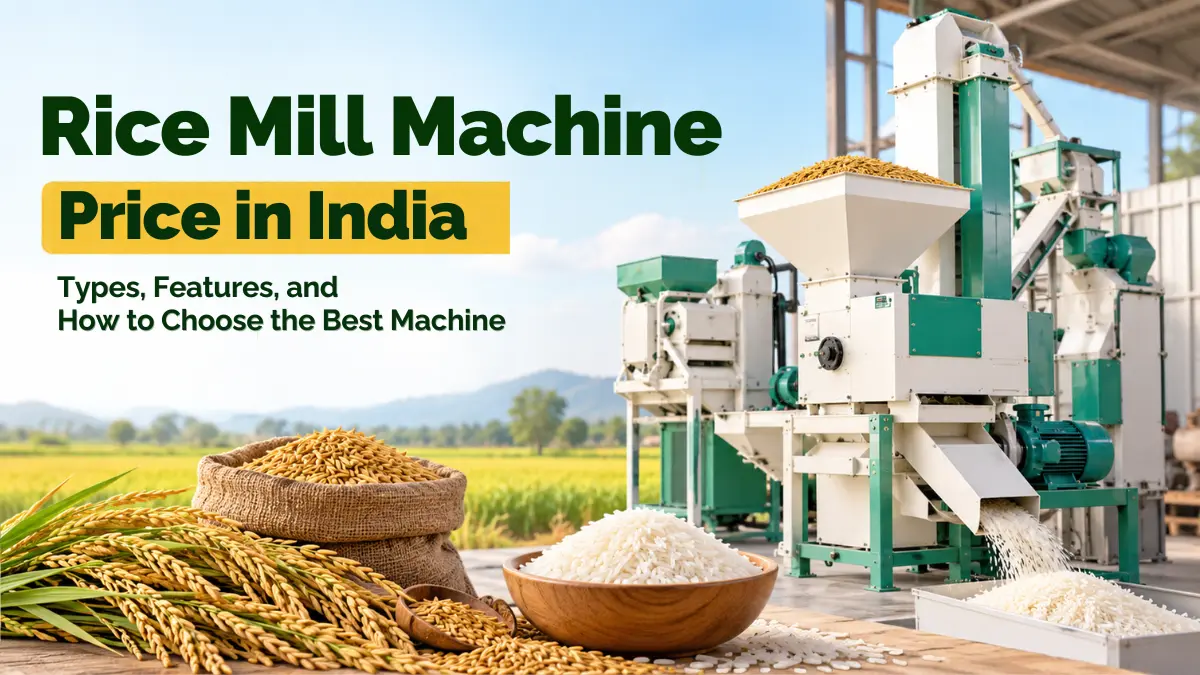
Rice is one of India's most important crops, and turning harvested paddy into market-ready rice requires proper milling equipment. A rice mill machine removes the outer husk, separates impurities, and processes paddy into rice suitable for consumption or sale.
Today, farmers, small business owners, and commercial rice processors can choose from compact mini rice mills, semi-automatic machines, and fully automatic rice milling plants. Each machine has different production capacities, electricity requirements, and investment costs.
If you are planning to start a rice milling business or purchase a machine for your farm, understanding the rice mill machine price in India, available types, and operating costs can help you make the right investment.
In this guide, we explain how rice milling machines work, their different types, estimated prices, important features, and how to select the best machine for your requirements.
Rice Mill Machine Price in India 2026
The rice mill machine price in India depends on processing capacity, motor power, automation level, and additional features such as polishing, grading, and sorting.
A basic mini rice mill can cost around ₹20,000–₹70,000, while complete commercial rice milling plants may require an investment of ₹15 lakh to ₹2 crore or more.
The following table provides indicative price ranges for 2026.
Rice mill machine type | Approximate price in India | Suitable for |
Basic mini rice mill machine | ₹20,000–₹70,000 | Farmers and household-scale processing |
Heavy-duty mini rice mill | ₹70,000–₹2 lakh | Small processing businesses |
Compact rice mill plant | ₹3–₹15 lakh | Village-level rice mills |
Semi-automatic rice mill plant | ₹15–₹60 lakh | Small and medium businesses |
Fully automatic rice mill plant | ₹60 lakh–₹2 crore+ | Large commercial rice mills |
These are broad market estimates, not fixed manufacturer quotations. Individual machines may cost less, while complete plants with advanced sorting and packaging systems can exceed these ranges.
Important: The price of a single rice mill machine is different from the total cost of setting up a rice milling plant. Land, buildings, electrical connections, installation, storage, and working capital may add significantly to the investment.
Also Read - Telangana Ration Card Status Check
Types of Rice Mill Machines in India
Different types of rice mill machines are available depending on the quantity of paddy being processed, the desired rice quality, and the available budget.
1. Mini Rice Mill Machine
A mini rice mill machine is a compact processing unit designed for farmers, small shops, and village-level businesses. It is generally easy to operate and requires less installation space than a commercial plant.
Some mini rice mills combine husking and whitening operations in a single machine, reducing the need for multiple pieces of equipment.
Main features:
Compact design and relatively low investment.
Suitable for small quantities of paddy.
Available with different electric motor capacities.
Simple operation and maintenance.
Best for: Farmers processing their own paddy, local service providers, and entrepreneurs testing a small rice milling business.
2. Semi-Automatic Rice Mill Machine
A semi-automatic rice mill uses mechanical equipment for major processing operations but still requires workers for certain activities, such as material handling, feeding, or packaging.
These machines are commonly selected by businesses that want higher production capacity without investing in a fully automated plant.
Main features:
Higher processing capacity than basic mini mills.
Separate or combined cleaning, husking, and polishing operations.
Moderate labour requirements.
Can be expanded with grading and sorting equipment.
Best for: Small and medium rice processing businesses serving local wholesale markets.
3. Automatic Rice Mill Machine
An automatic rice mill integrates multiple processing operations into a connected production line. Depending on the plant configuration, paddy cleaning, husking, separation, whitening, grading, and packaging can be handled with limited manual intervention.
Modern automatic plants may also use sensors, electronic controls, and optical sorting equipment to improve consistency.
Main features:
Continuous processing with automated material handling.
Better control over production settings.
Suitable for large quantities of paddy.
Can include colour sorting and automatic packaging.
Higher initial investment and infrastructure requirements.
Best for: Established rice mill owners, large agricultural businesses, and commercial rice processors.
4. Traditional Rice Huller Machine
A traditional rice huller is a basic machine used to remove the outer husk of paddy. Some older huller designs also remove bran during processing.
Although these machines are relatively simple, older milling methods may produce more broken grains and lower head-rice recovery than properly configured modern multi-stage systems.
Best for: Small operations where equipment cost is the main consideration and premium rice grading is not required.
5. Modern Multi-Stage Rice Mill
A modern multi-stage rice mill processes paddy through separate machines instead of relying on one combined milling unit.
The process usually includes cleaning, dehusking, paddy separation, whitening, polishing, and grading. Each stage can be adjusted to improve processing consistency and control grain breakage.
Best for: Businesses producing graded rice for branded retail, wholesale distribution, or export markets.
Important Machines Used in a Rice Milling Plant
A complete rice mill requires more than a single machine. The equipment depends on the type of rice being produced and the level of processing required.
Machine | Main function |
Paddy cleaner | Removes dust, straw, and lightweight impurities |
Destoner | Separates stones and other heavy impurities |
Paddy husker | Removes the outer husk |
Paddy separator | Separates brown rice from unhusked paddy |
Rice whitener | Removes the bran layer to produce white rice |
Rice polisher | Improves the surface finish of rice |
Rice grader | Separates whole and broken grains |
Colour sorter | Removes discoloured and defective grains |
Paddy dryer | Reduces paddy moisture before processing |
Rice packaging machine | Weighs and packs processed rice |
These machines are commonly used in modern rice milling systems, although smaller plants may combine several operations in one unit.
How Does a Rice Mill Machine Work?
The rice milling process involves several steps, from cleaning harvested paddy to preparing finished rice for packaging.
Rice milling process
Raw Paddy
Harvested and appropriately dried grains
Cleaning and Destoning
Remove dust, straw, and stones
Husking and Separation
Remove husk and separate unhusked paddy
Whitening and Polishing
Produce white rice with the required finish
Grading and Sorting
Separate broken and defective grains
Finished Rice
Ready for weighing, packaging and sale
For brown rice production, the whitening and polishing stages are omitted. Parboiled rice requires additional processing before milling.
Which Is the Best Rice Mill Machine in India?
The best rice mill machine depends on how much paddy you want to process, your budget, available electricity, and the quality of rice required by your customers.
A large automatic machine is not necessarily the best choice for a farmer processing only a few hundred kilograms of paddy per day.
Here is a practical comparison.
Requirement | Recommended machine |
Small farm or household processing | Mini rice mill |
Village-level milling service | Heavy-duty mini or compact mill |
Growing rice processing business | Semi-automatic rice mill |
High-volume commercial production | Automatic rice mill |
Premium graded rice production | Multi-stage mill with grader and colour sorter |
When comparing rice mill machines, check the actual paddy input capacity rather than relying only on the motor horsepower or advertised rice output.
Also request a demonstration using the type of paddy you plan to process. This helps you evaluate grain breakage, recovery, and processing quality before purchasing.
Mini Rice Mill vs Automatic Rice Mill Differences
Feature | Mini rice mill | Automatic rice mill |
Investment | Low | High |
Processing capacity | Small | Medium to very large |
Space required | Limited | Larger plant area |
Labour | More manual handling | Less manual handling per tonne |
Electricity | Lower overall requirement | Higher connected load |
Processing stages | Often combined | Multiple integrated stages |
Best suited for | Farmers and small businesses | Commercial processors |
An automatic rice mill can reduce manual handling and improve consistency, but the investment is worthwhile only when the business has sufficient paddy supply and market demand.
How Much Does It Cost to Start a Rice Mill Business in India?
The total investment in a rice milling business depends on plant capacity, location, equipment, and infrastructure.
For example, consider a small commercial rice mill project with a machinery budget of ₹8 lakh.
Expense | Illustrative cost |
Rice milling machinery | ₹8,00,000 |
Electrical installation | ₹1,00,000 |
Shed preparation and basic civil work | ₹2,00,000 |
Installation and transportation | ₹50,000 |
Initial maintenance and other expenses | ₹50,000 |
Estimated fixed setup cost | ₹12,00,000 |
This is a hypothetical planning example, not a supplier quotation. Land purchase, substantial construction, permits, raw paddy inventory, salaries, and working capital are excluded.
Before starting, business owners should calculate the cost of buying paddy, expected rice recovery, electricity consumption, labour, packaging, and transportation.
How Much Rice Can Be Produced from 100 kg of Paddy?
Rice recovery is one of the most important factors affecting profitability.
For a simple illustration, assume a mill produces 65 kg of finished milled rice from 100 kg of paddy.
Illustrative rice recovery from 100 kg of paddy
Rice
65 kg
Husk
20 kg
Other
15 kg
Illustrative mass balance only. “Other” includes bran, losses and other separated material. Actual results depend on paddy variety, moisture, machinery and milling settings.
A higher percentage of whole, unbroken rice can improve selling value. Therefore, buyers should compare not only total rice recovery but also head-rice recovery when testing different machines.
Rice Mill Machine Electricity Consumption
Electricity is an important operating expense, especially for commercial rice mills.
The power requirement depends on motor size, processing capacity, machine efficiency, and whether additional equipment such as dryers, polishers, and colour sorters is installed.
For example, a machine drawing an average of 7 kW during operation and running for six hours would consume:
7 kW × 6 hours = 42 kWh (42 units)
At an illustrative electricity rate of ₹8 per unit, the daily energy cost would be ₹336.
Actual electricity expenses may also include fixed charges, demand charges, and taxes. Motor horsepower alone does not determine actual consumption.
How to Choose a Rice Mill Machine Before Buying
Buying a rice mill machine is a long-term investment. Consider the following factors before selecting equipment.
1. Processing capacity: Calculate how much paddy you expect to process per hour or day. Avoid purchasing an oversized plant that will remain underutilised.
2. Machine quality: Examine the build quality, rollers, bearings, motors, and other components. Ask the supplier about expected maintenance intervals.
3. Rice recovery and breakage: Request a live milling test using your paddy variety. Compare the percentage of whole rice and broken grains.
4. Electricity availability: Confirm whether the machine needs single-phase or three-phase electricity and whether your existing connection can support it.
5. Spare parts and service: Check whether replacement rollers, belts, screens, and other parts are readily available in your region.
6. Total installation cost: Compare complete quotations that include motors, conveyors, electrical panels, installation, transportation, and applicable taxes.
7. Future expansion: If you plan to increase production, consider machinery that allows additional grading, polishing, or sorting equipment to be installed later.
Also check out: Farm Machinery
Benefits of Using a Modern Rice Mill Machine
Modern rice milling equipment offers several advantages compared with traditional manual processing.
Faster processing: Larger quantities of paddy can be processed in less time.
Improved rice quality: Controlled husking and polishing can reduce grain damage.
Reduced manual handling: Automated conveyors and feeding systems help reduce labour requirements.
Better grading: Separating whole and broken rice allows businesses to sell different grades.
By-product utilisation: Rice husk and bran may have commercial uses, depending on their quality and local demand.
Business opportunities: Small mills can offer custom milling services to farmers, while larger units can supply wholesalers and retailers.
However, these benefits depend on correct machine selection, operator training, maintenance, and the quality of the incoming paddy.
Common Problems in Rice Mill Machines and Their Solutions
Problem | Possible cause | What to check |
Excessive broken rice | Incorrect roller pressure or paddy moisture | Adjust milling settings and check moisture |
Low rice recovery | Poor-quality paddy or inefficient separation | Inspect paddy quality and separator settings |
Machine overheating | Overloading or inadequate maintenance | Check load, lubrication, and ventilation |
Uneven polishing | Worn components or incorrect settings | Inspect whitener and polisher |
High electricity consumption | Overloading or inefficient operation | Check motor load and production efficiency |
Frequent blockages | Excess impurities or excessive feeding | Clean equipment and adjust feed rate |
Always switch off and isolate the electrical supply before maintenance. Internal repairs and electrical work should be carried out by trained personnel.
Conclusion
Choosing the right rice mill machine in India requires balancing machine price, processing capacity, rice quality, and operating costs.
For farmers and small entrepreneurs, a mini rice mill offers an affordable entry point into rice processing. Medium-sized businesses may benefit from semi-automatic systems, while large commercial processors can consider fully automatic rice mills with grading and sorting equipment.
Before buying, compare quotations from multiple manufacturers, verify machine capacity, and request a live processing demonstration. The best rice mill machine is the one that meets your production needs while delivering consistent rice quality at a manageable operating cost.