
The Future of Indian Agri-Tech Depends on What Works in the Field
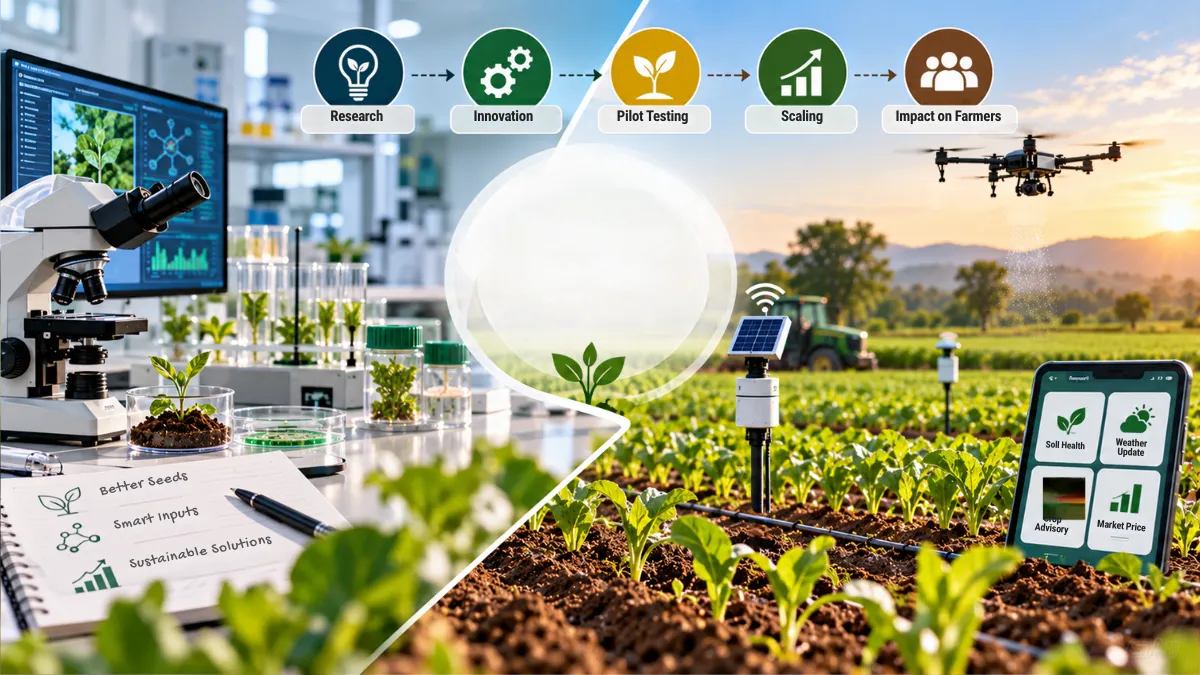
The future of Indian agri-tech will be decided by whether farmers keep using a service after the demonstration ends. A sensor, advisory app or crop-grading machine may work well in a controlled setting. The harder test begins when connectivity is weak, the field is irregular, a component fails or a decision must be made before the next rain.
India should support agricultural innovation, but support should increasingly reward dependable use. A successful launch and a successful farming service are different stages of the same journey.
India already has an incubation foundation
In July 2024, the Agriculture Ministry described an RKVY-supported network of five knowledge partners and 24 agribusiness incubators. The programme provides financial and technical support for agricultural entrepreneurship. These are dated programme figures, not a claim about the exact size of the network today. Source: Agriculture Ministry.
This foundation matters because agricultural products need technical knowledge, testing facilities and patient development. The next question is how to connect those resources with the conditions in which farmers actually work.
Incubation should treat field deployment as a core part of product development. Testing should help a founder discover where a product fails, which users need assistance and whether the benefit justifies the full cost.
Start with a decision that the farmer must make
A farmer does not need a dashboard simply because data can be displayed. The useful starting point is a decision: when to irrigate, whether a crop symptom needs action, which lot meets a buyer’s grade or when a machine can be hired.
A service should explain what action follows from its information. It should also state when the information is uncertain and when a human adviser needs to inspect the field.
This is particularly important for image-based crop diagnosis. A confident label on a phone screen should not encourage unnecessary treatment when the available image cannot establish the cause. Good product design includes a way to ask for better information and to refer difficult cases.
Field evidence should cover ordinary conditions
Publicly supported trials should include different seasons, farm sizes and operating conditions. The existing practice should be recorded so that improvements have a meaningful comparison.
A report saying “yield increased” is incomplete without the crop, location, season, sample and cost of achieving that increase. Was the change caused by the technology, better inputs, extra attention from the project team or favourable weather? Some trials cannot fully separate these influences, and should say so.
Failed installations and farmers who stopped using a product deserve attention too. They can reveal problems hidden by a presentation built only around successful users.
Affordability is about the whole service
A low purchase price may still leave a farmer with substantial expenses for installation, maintenance, mobile data or replacement parts. Conversely, an expensive machine may become practical through a reliable rental service.
Startups should compare ownership, pay-per-use and service-provider models according to the task. A small farmer may need accurate soil information once in a while, rather than owning equipment that spends most of the year unused.
FPOs, cooperatives and local entrepreneurs can help deliver shared services. Their involvement should include clear responsibility for booking, maintenance and complaints, with a workable margin for the local operator.
Local support belongs in the product
A helpline that cannot resolve a field problem is not sufficient support. Users need someone who understands the crop calendar, speaks their language and can explain the next step clearly.
That does not mean every startup must build a large field team. Partnerships with capable local service providers may be more practical. But the cost and quality of that support should be included in the business plan from the beginning.
A product that requires repeated unpaid help from research staff may still be a useful prototype. It has not yet demonstrated a sustainable delivery model.
Farmer data needs clear boundaries
Digital services should explain what information they collect, why they need it and who may receive it. Farmers should be able to understand whether an advisory is independent or linked to a product sale.
Public programmes can encourage plain-language consent, sensible data collection and usable records that farmers can retain. These are editorial recommendations for trustworthy service design, not a substitute for compliance with applicable data law.
Trust can be damaged if a farmer signs up for crop advice and later discovers an unrelated use of personal or farm information that was never clearly explained.
Change the way success is reported
A useful evaluation should look beyond registrations and downloads. It should ask how many farmers used the service again, what they paid, how quickly problems were resolved and whether their net benefit remained positive.
The best route from lab to land is repeated learning with farmers. India’s agri-tech ecosystem should make room for careful testing, honest reporting and businesses that solve a narrow problem well. A dependable service in the next village can be more valuable than an impressive demonstration that cannot be repeated.