
Agricultural Education Must Give Field Training Greater Weight
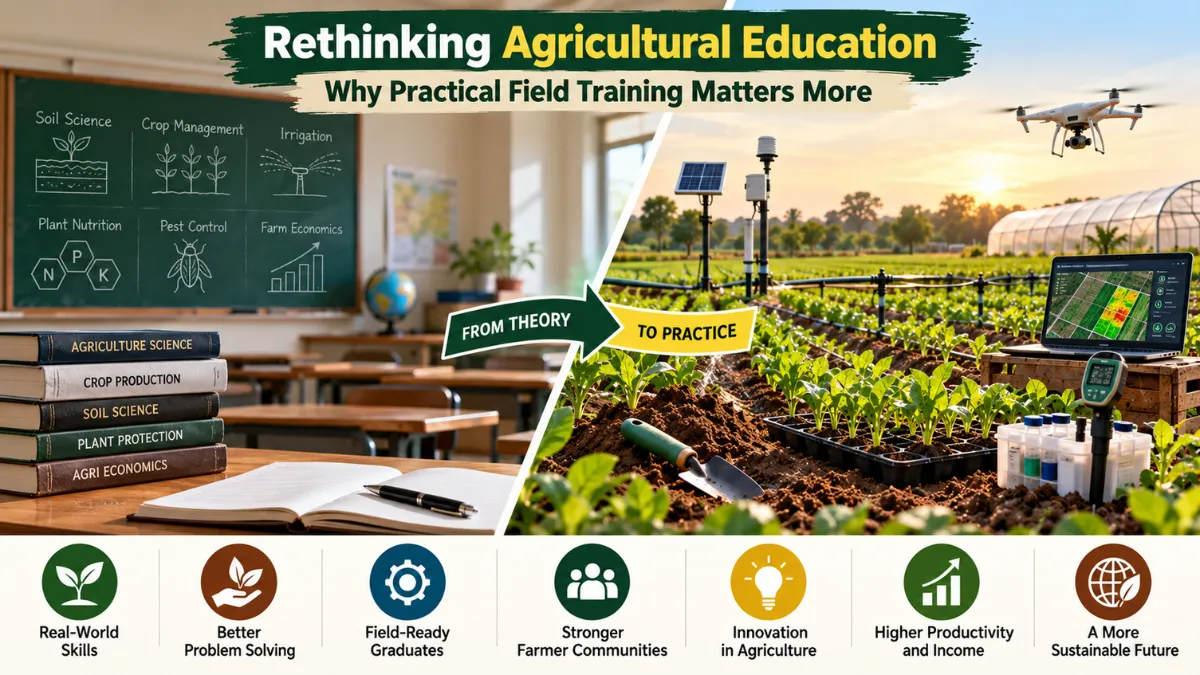
An agricultural graduate should be able to explain a recommendation to a farmer, calculate its cost and recognise when the available evidence is insufficient. Classroom learning provides the scientific foundation for that work. Field training tests whether the student can use it responsibly.
Indian agricultural education should give that practical ability greater weight in assessment. A degree should demonstrate more than the ability to reproduce a recommended practice in an examination. It should show that the student can adapt knowledge to the crop, soil, resources and uncertainty of an actual farm.
The foundation already exists
ICAR’s Student READY framework includes Rural Agricultural Work Experience, agro-industrial attachment and experiential learning. The need for practical exposure is therefore already recognised in agricultural education.
ICAR-VPKAS has also documented RAWE programmes in which students learned about cultivation, soil management, crop protection, rural development and technology transfer while working with farmers and researchers. These are examples of field activity, not evidence that every programme delivers the same quality.
The reform question is how consistently institutions turn exposure into demonstrated competence.
Students should follow decisions through the season
A single visit can introduce a crop or village. It offers less opportunity to understand why a farmer changed a decision after rainfall, labour shortages or a price movement.
Where the academic calendar permits, students should follow selected fields across important crop stages. They should record the initial plan, what changed, why it changed and the outcome. Follow-up can combine visits with supervised remote contact when repeated travel is difficult.
The exercise should reward accurate observation. A report showing that a recommendation could not be implemented may contain more learning than a polished account that omits the difficulty.
Make practical assessment specific
Institutions should define tasks that graduates are expected to perform safely and accurately. The exact list will differ by course, but core abilities can be tested directly.
| Skill | Example of a practical assessment |
|---|---|
| Soil sampling | Collect and label a representative sample, explaining limitations |
| Nutrient planning | Convert a recommendation into product quantities and cost |
| Crop diagnosis | Distinguish observations from possible causes and request missing evidence |
| Irrigation assessment | Identify uneven application and explain what needs checking |
| Farm economics | Prepare a budget that includes labour and selling expenses |
| Communication | Explain a recommendation in language the farmer understands |
| Record keeping | Maintain a traceable field, input and harvest record |
Students should be allowed to say, “This needs laboratory confirmation,” or “I need supervision before recommending treatment.” Recognising the limit of one’s competence is a professional skill.
Include the market after harvest
A student may understand crop production well but have little experience with grading, storage charges, purchase records or payment disputes. Field education should follow the crop beyond harvest.
A visit to a functioning FPO, pack house, warehouse or procurement centre can support a practical assignment. Students could compare gross selling prices with net receipts, document quality requirements or examine how small lots are aggregated.
These exercises should use permission-based access and protect private business information. The objective is to understand a transaction, not to publish a farmer’s financial details without consent.
Treat farmers as teaching partners
Farmers contribute time, access and knowledge to student learning. Institutions should make the purpose and limits of each activity clear and provide a useful return, such as a reviewed field record or an explanation of test results.
Students should not conduct unsupervised experiments on a farmer’s crop simply to complete an assignment. Any intervention needs informed agreement, appropriate supervision and a clear account of responsibilities.
Where farmers undertake substantial mentoring, programmes should consider fair recognition or compensation. Field training becomes more meaningful when the relationship is designed as a partnership.
Give supervisors the time to supervise
Adding more compulsory field days without staff, transport and working equipment can increase paperwork rather than learning. Faculty members need time to review records, visit sites and discuss mistakes with students.
Institutions should also provide safe accommodation and travel arrangements where placements require them. Access to good training should not depend on a student’s ability to pay substantial additional costs or arrange personal connections.
Placement quality should be evaluated through student work, mentor feedback and the suitability of assigned tasks. Attendance is necessary, but it is a weak measure of competence on its own.
Keep the science strong
Greater practical emphasis should deepen scientific understanding. A student who observes nutrient symptoms still needs soil chemistry and plant physiology to interpret them. Someone evaluating a trial needs statistics to avoid turning a coincidence into a recommendation.
Field experience and laboratory learning should therefore inform each other. The field generates questions; scientific methods help examine them; supervised application reveals what remains uncertain.
Agricultural education will serve India better when graduation demonstrates that a student can observe carefully, reason clearly and communicate honestly under real conditions. Practical training should carry enough weight that those abilities matter as much as the final written answer.