
India’s Groundwater Crisis Needs a Change in Farm Incentives
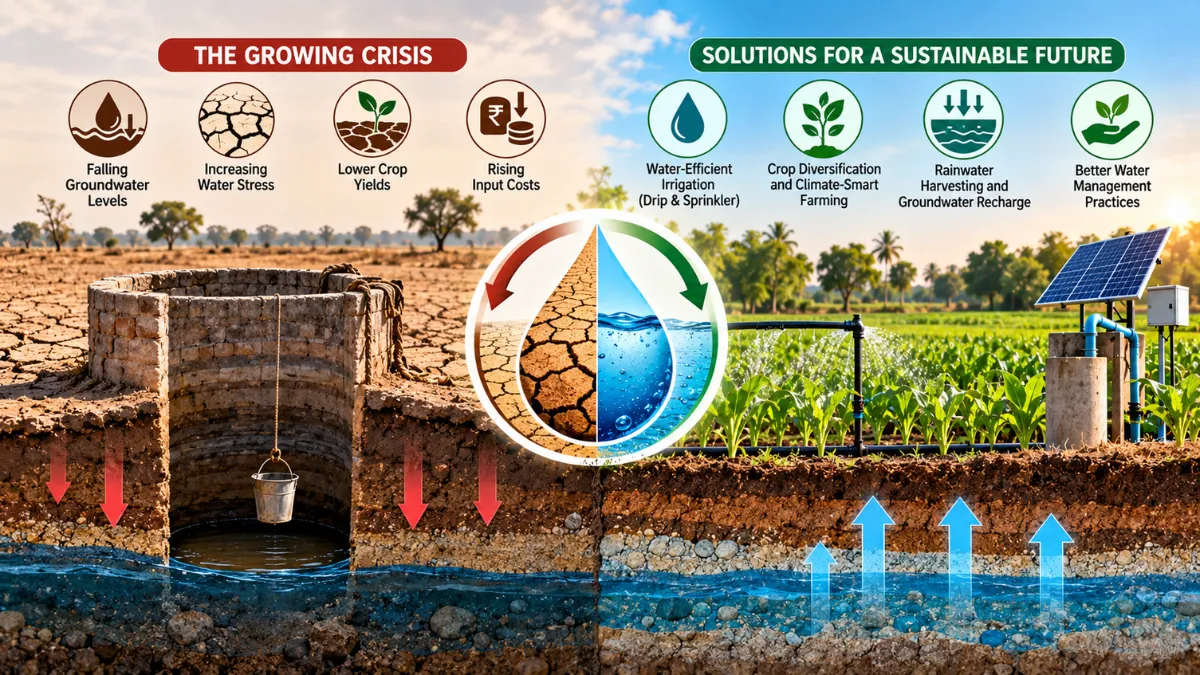
Groundwater depletion should be treated as a farm-livelihood issue. Where water becomes harder to reach, the consequences can extend to irrigation reliability, investment decisions and the ability to continue cultivating a crop.
Farmers make those decisions within the market and policy conditions available to them. A serious response must therefore address crop profitability, irrigation services and energy incentives alongside conservation. Appeals to “save water” are unlikely to be enough when the financially dependable crop requires substantial irrigation.
National figures do not describe every aquifer
A Jal Shakti Ministry reply in August 2026, citing the 2025 groundwater assessment, reported annual extraction of about 247 billion cubic metres, of which 215 billion cubic metres, or 87%, was used for irrigation. It put the national stage of extraction at 60.63%. Source: Ministry of Jal Shakti.
The stage of extraction compares annual extraction with the assessed annual extractable resource. It is not a statement that 60.63% of all underground water has been used up.
Nor does a national average establish that every locality is safe. The same reply identifies states and districts with higher extraction ratios. A ratio above the national average is not automatically the same as an over-exploited classification; local assessment must guide that judgement.
This is why groundwater policy needs aquifer and local-area information rather than a single national message.
Begin with a usable local water account
Farmers should be able to see an understandable picture of seasonal availability, extraction pressures and changes in monitored water levels. The information should be discussed before crop planning, when decisions can still change.
CGWB’s monitoring programme measures groundwater levels at different times of the year. Such observations are useful because one reading after rain can give a misleading impression of longer-term security. Source: CGWB monitoring programme.
Local water accounts will contain uncertainty. That is a reason to improve monitoring and explain assumptions, rather than to promise an exact quantity that every well can supply.
Make water-saving crop choices financially credible
A farmer considering a different crop needs more than a statement that it uses less water. Suitable seed, agronomic advice, buyers, quality standards and a realistic income comparison are also necessary.
A diversification programme should begin by identifying crops suited to local soil and climate, then work backwards from dependable demand. Support for the transition should acknowledge the learning and marketing risk carried by the farmer.
This may cost more effort than announcing an acreage target. It also offers a better chance of maintaining the change after temporary incentives end.
Irrigation efficiency needs an extraction goal
Drip and sprinkler systems can improve control over water application. The government’s Per Drop More Crop programme supports these technologies, and official evaluations report benefits for water use and farm returns. Source: PDMC review.
But a policy inference follows: a saving on each hectare will not necessarily reduce total pumping if the farmer uses it to irrigate a larger area or add another crop. Efficiency and total extraction must be measured separately.
Projects should therefore assess the volume withdrawn and the wider cropping response, where reliable measurement is possible. Counting installed systems alone cannot establish aquifer recovery.
Energy reform must protect vulnerable users
Pumping decisions are influenced by the cost and reliability of energy. Solar pumps can improve access to power, but water safeguards need to be considered when the operating cost of an additional pumping hour becomes very low.
The answer should not be an abrupt withdrawal of support from households that depend on irrigation. Reform should combine dependable electricity, workable conservation incentives and protection for small farmers with limited alternatives.
Any model that rewards unused energy or reduced pumping needs local testing and transparent payment arrangements. Farmers should be able to understand how the promised benefit is calculated and whether it compensates for the change in practice.
Recharge projects need technical judgement
Rainwater harvesting and recharge can form part of the response, but every structure needs an appropriate site, design and maintenance plan. Water quality also matters. Sending contaminated runoff underground can create another problem.
Recharge should complement demand management. A district should avoid presenting new structures as proof that unrestricted extraction can continue indefinitely.
The test should be whether the intervention improves the local water balance and remains functional, with monitoring appropriate to the site.
Shared rules need fair representation
Groundwater management affects people differently. Farmers with shallow wells, tenants and households relying on common drinking-water sources may have different priorities from owners of deeper wells.
Village discussions should include those users, and proposed restrictions should be accompanied by practical alternatives. Conservation rules will be harder to sustain if households with the least bargaining power carry most of the adjustment.
India needs a groundwater policy that farmers can live with: credible local information, profitable crop options, well-maintained irrigation and incentives linked to actual water outcomes. Protecting the aquifer and protecting rural incomes must be planned together.