
Is MSP Reaching Small Farmers Where It Matters Most?
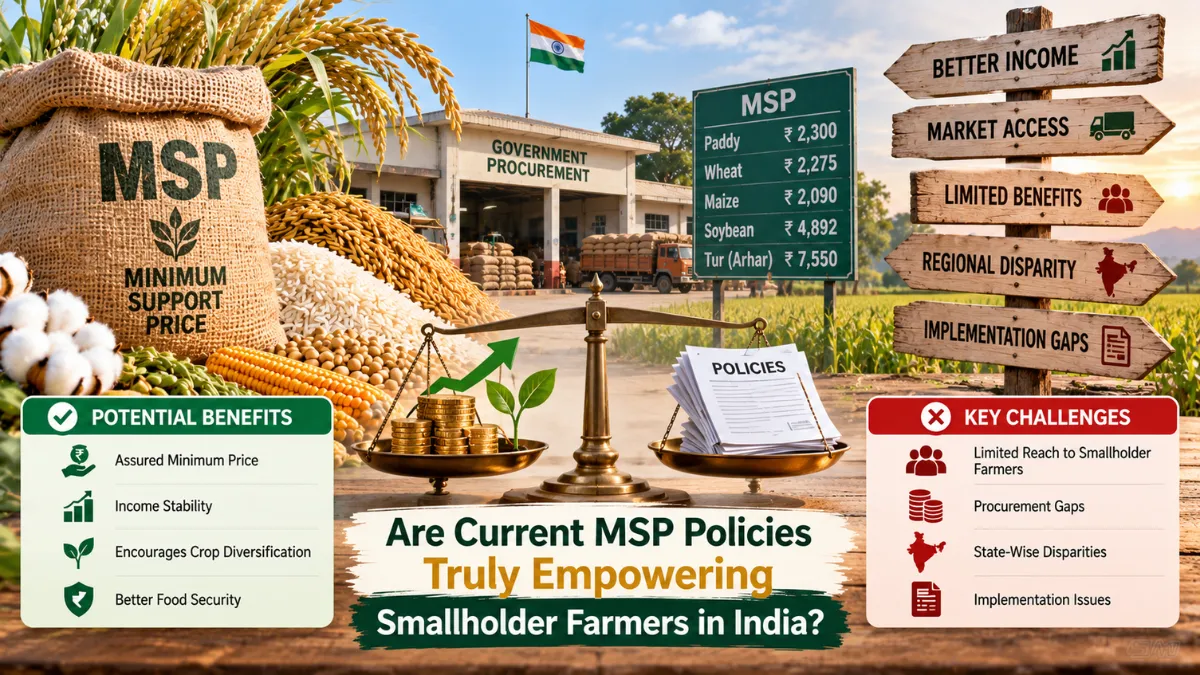
Minimum Support Price can strengthen a farmer’s position when it provides a credible selling option. The policy deserves to be judged by how effectively that option reaches the farmer with a small marketable surplus and limited ability to wait.
The debate becomes less useful when every MSP increase is treated as proof of empowerment, or when procurement is dismissed as if it provides no benefit. Both positions avoid the practical question: who can use the support, at what cost and within what time?
An announcement and a purchase are different steps
The government approved MSPs for 14 kharif crops for the 2026–27 marketing season in May 2026. That establishes notified rates; it does not by itself establish an operating purchase centre for every crop in every district. Source: official MSP announcement.
Procurement arrangements differ. The Department of Food and Public Distribution describes wheat and paddy purchases through FCI and state agencies, subject to the stipulated period and quality specifications. The Agriculture Ministry’s March 2026 explanation of the Price Support Scheme describes procurement of notified pulses, oilseeds and copra following state requests and other programme conditions. Sources: DFPD procurement policy and Agriculture Ministry.
These details are central to the farmer’s experience. A support price has greater bargaining value when the alternative buyer is accessible and dependable.
Small lots change the economics of access
Consider an illustrative farmer with five quintals to sell. If a purchase centre offers ₹200 per quintal more than a nearby buyer, the gross advantage is ₹1,000. Additional transport, handling and time costs of ₹800 reduce that advantage to ₹200.
This is not a survey result or a statement of current mandi prices. It shows why access costs can matter disproportionately for a small lot.
Procurement policy should account for those costs. Village aggregation, sensible booking systems and well-placed collection points can make an existing support price more useful without changing the announced rate.
Payment time affects selling power
A farmer who needs money for the next sowing or an urgent household expense may place a high value on immediate payment. Policy should recognise that choice rather than assuming every farmer can wait for a better nominal price.
Reliable payment timelines should therefore be treated as part of price support. A complaint mechanism should tell the farmer why payment is pending, which office is responsible and what happens next.
This also makes working capital relevant. Access to reasonably priced short-term finance can improve a farmer’s ability to choose when and where to sell. It should complement procurement, with clear terms that do not create an unmanageable debt burden.
Quality rules should be clear before delivery
Public procurement requires quality standards. The issue is whether farmers know the standards early enough and can obtain a fair, understandable assessment.
Local moisture testing, accessible drying facilities and written reasons for rejection would make the process more transparent. A farmer should be able to distinguish a correctable quality problem from a crop or registration mismatch.
Re-testing and grievance procedures also deserve attention. Trust in the process is weakened when a farmer cannot understand why one lot was accepted and another was refused.
Measure access, not only tonnes
Procurement totals are useful for managing food stocks and expenditure. They do not fully describe how benefits are distributed.
Evaluation should also report the number of participating small producers, average quantity purchased from them, travel and transaction costs, rejection reasons and payment delays. Where feasible, it should examine barriers faced by actual cultivators whose documents do not fit the usual registration process.
This article does not claim that only a particular percentage of Indian farmers benefits from MSP. Such a statement needs a dated dataset, a clear definition of benefit and attention to differences between crops and regions.
Reform needs an honest account of trade-offs
Expanding purchases requires money, storage, movement and an eventual use for the crop. A proposal to strengthen support should explain those responsibilities rather than assuming procurement is costless.
Price-deficiency payments also need scrutiny. They depend on reliable records of actual sales and reference prices, and require safeguards against manipulation. They should be evaluated against the difficulties they solve and the new problems they may introduce.
Crop diversification adds another test. Farmers need viable buyers and production support for alternative crops. Asking them to change while leaving the marketing risk entirely with them is unlikely to build confidence.
Empowerment means having a workable choice
MSP should remain part of a wider effort to improve farmers’ selling options. Better procurement access, transparent grading, timely payment, storage services and competitive markets can reinforce one another.
For a small farmer, the meaningful result is the ability to sell a manageable quantity at a fair net return without an unreasonable wait. That should be a central measure of success whenever the next MSP announcement is assessed.