
Why India Must Give Post-Harvest Management Greater Priority
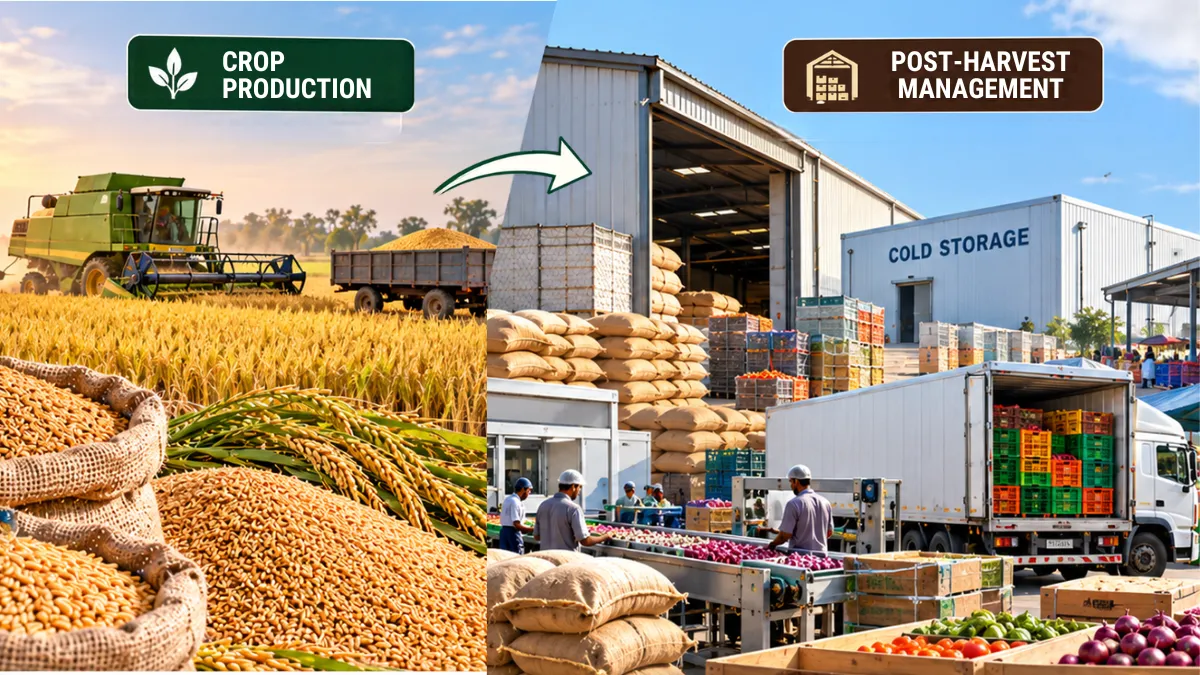
India should judge agricultural progress by how much value reaches the farmer after harvest. Tonnes produced remain important, but they are an incomplete measure of success. A crop that loses quality, cannot reach a buyer or must be sold immediately under financial pressure does not deliver its full economic value.
The next stage of agricultural investment should give post-harvest management a much stronger place. Production research must continue, especially where yields are low or climate risks are rising. But every production target should be accompanied by a credible plan for handling and selling the additional crop.
The losses are measurable, but differ across crops
The Ministry of Food Processing Industries commissioned a NABCONS study published in 2022, with a reference period of 2020–22. Its reported loss ranges were 3.89–5.92% for cereals, 6.02–15.05% for fruits and 4.87–11.61% for vegetables. These are ranges across the commodities studied, not one loss rate applying to every farm or district. Source: MoFPI’s parliamentary reply.
The figures are sufficient to show that protecting the harvest deserves serious investment. There is no need to repeat an unsupported claim that a third of all Indian agricultural produce is wasted.
They also point towards a practical policy principle: identify the loss before choosing the infrastructure. Grain needing proper drying, an onion lot needing suitable ventilation and a highly perishable vegetable needing rapid cooling cannot all be served by the same design.
Begin with the first few kilometres
A large processing plant cannot recover quality already lost before the crop reaches it. The first stage after harvest deserves more attention in project planning: shade, suitable containers, sorting space, access roads, loading arrangements and timely collection.
These facilities may look modest compared with a major cold-store inauguration. Their value should be judged through the crop handled and the income retained, rather than the size of the building.
District plans should ask farmers and buyers where the actual difficulty occurs. Is produce waiting too long for transport? Are small lots difficult to aggregate? Is quality being damaged during loading? Is there a buyer, but no dependable collection schedule? Each answer suggests a different investment.
Storage must come with a business plan
Storage can give a farmer time, but that time has a cost. Rent, interest, weight loss, handling and deterioration can absorb a later price increase. Advising every farmer to hold produce until prices rise is therefore poor policy.
A hypothetical example makes the point. Suppose storing a lot produces ₹10,000 of additional sale revenue but adds ₹7,000 in storage, finance and handling costs. The benefit is ₹3,000 before any other losses. If the price increase fails to appear, the same decision may reduce the farmer’s return.
Publicly supported facilities should publish clear charges, service conditions and claims procedures. Farmers should know the expected cost before handing over produce, and responsibility should be clear if a service failure damages the lot.
Small farmers need access to the service
A village can be close to a warehouse and still lack usable storage. Minimum lot sizes, payment terms, booking processes and transport costs may make a facility impractical for a farmer with a small surplus.
FPOs and cooperatives can help aggregate these lots, but aggregation itself needs management. Staff must maintain lot identity, record quality and explain deductions. A shared facility without working capital or trained operators is unlikely to solve the marketing problem.
Government support should therefore include viable operations and farmer access. Funding only construction leaves unanswered questions about who will run the facility after the project team leaves.
Measure the outcome after commissioning
MoFPI and horticulture programmes already support parts of the post-harvest chain, including cold storage, pack houses and processing infrastructure. The policy question is how effectively those assets serve farmers. Source: MoFPI, July 2025.
A useful district report would track the volume handled, share of small-farmer users, operating costs, quality losses and payment time. It should also compare farmers’ net returns before and after using the service, while accounting for changes in market prices.
Physical loss and financial distress should be measured separately. Produce sold cheaply is not necessarily physically wasted, but the low return can still threaten the farmer’s ability to finance the next crop.
Make the harvest-to-payment journey part of farm policy
Better post-harvest management can protect investments already made in land preparation, seed, water and labour. Its value extends from the field to the household budget.
India should continue improving crop productivity while making the journey from harvest to payment a central policy responsibility. The strongest project is one that farmers can afford to use, buyers can rely on and local operators can maintain season after season.