
How to Identify and Treat Fall Armyworm in Maize Crops Early
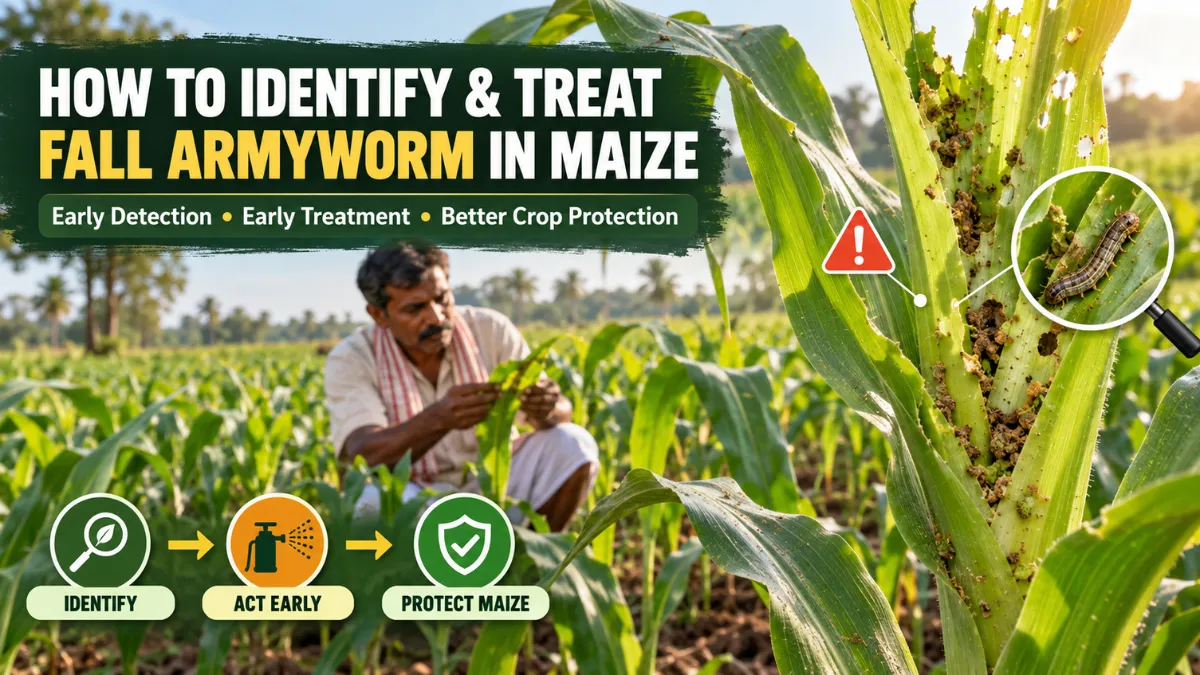
White patches and small holes on young maize leaves can be an early sign of fall armyworm. As the caterpillar grows, damage becomes more obvious, with torn leaves and waste collecting inside the central whorl.
Do not wait for the whole field to look damaged. Start checking soon after seedlings emerge and confirm the pest before choosing a treatment. Early detection gives you more scope to act while the larvae are small.
What Is Fall Armyworm?
Fall armyworm, Spodoptera frugiperda, is an insect whose caterpillar stage damages maize. It was reported in India in 2018. ICAR-IIMR researchers have studied its life cycle under Indian conditions to support management of this invasive pest.
The whorl is the rolled central group of young leaves at the top of the plant. It provides a protected feeding place, so a quick look at the outer leaves alone may miss an active larva.
Early Signs to Look For
The Indian fall armyworm identification brochure hosted by ICAR-NBAIR describes young larvae scraping leaves and creating pale, partly transparent patches. Larger larvae make ragged holes and leave frass, which is caterpillar waste, around the whorl.
Look for the insect as well as the damage. Older leaf holes remain visible even after the larva has died or moved away.
| Observation | Next check |
|---|---|
| Pale window-like leaf patches | Look for young larvae and egg masses |
| Fresh ragged holes | Inspect the whorl carefully |
| Moist sawdust-like waste | Check for active feeding inside the whorl |
| Damaged cob | Ask for stage-specific advice; do not assume an early-crop spray instruction fits |
How to Recognise the Caterpillar
Two useful features on a larger larva are a pale inverted Y-shaped mark on the head and four dark spots arranged roughly as a square near the rear of the body.
These markings can be difficult to see on very small larvae. Take clear photographs of the head, body and damaged plant for the KVK if you are uncertain. Leaf holes alone cannot distinguish every maize-feeding insect.
Check the Field Systematically
Walk through several parts of the field, including the middle. A practical record can cover five locations with ten plants checked at each location. This is a simple recording method, not a universal official sampling rule.
Note the number of plants with fresh damage, whether live larvae are present and the crop stage. Use your local advisory's action threshold to decide treatment; thresholds vary with stage and the way damage is assessed.
Pheromone traps can help monitor moth activity, but a trap catch does not tell you how many plants currently have damaging larvae. Field inspection is still needed.
Early Management Options
Where practical, remove and destroy identified egg masses and small larval groups without unnecessarily damaging the crop. Protect natural enemies and follow locally suitable planting and crop-management practices.
Indian advisories include neem-based and microbial options for appropriate stages. Use a suitable registered product and follow its crop, pest and application directions. A biological product for another caterpillar should not be assumed to work against fall armyworm.
Avoid putting kerosene, diesel or unlabelled chemical mixtures into the whorl. Such practices can damage plants and expose workers without providing a dependable treatment.
Chemical Options in Indian Guidance
In a maize awareness programme reported on 17 July 2026, Punjab Agricultural University named chlorantraniliprole 18.5% SC, spinetoram 11.7% SC and emamectin benzoate 5% SG as treatment options. It also stressed directing the spray towards the whorl for effective coverage.
Treat these as alternatives to assess with the current local advisory and exact product label, not as ingredients to mix together. The required dose and water volume depend on the formulation and crop-stage instructions.
Use the correct protective equipment and stay within application limits. If another treatment is needed, follow resistance-management guidance on mode of action. Changing the brand while keeping the same insecticide is not a proper rotation.
Check Fresh Growth After Treatment
Inspect for live larvae and new feeding at the advised assessment interval. Previously damaged leaves will not become whole again, so old holes should not trigger automatic repeat spraying.
If damage continues, review pest identification, larval size, coverage and weather before selecting another treatment. Ask for help if larvae are deep inside cobs or the crop is close to harvest.
Sweet corn, grain maize and fodder maize can have different harvest uses and label requirements. Do not feed recently treated plants to livestock without checking the relevant restrictions.