
KCC Interest Subsidy Rules and State-Wise Benefits Explained
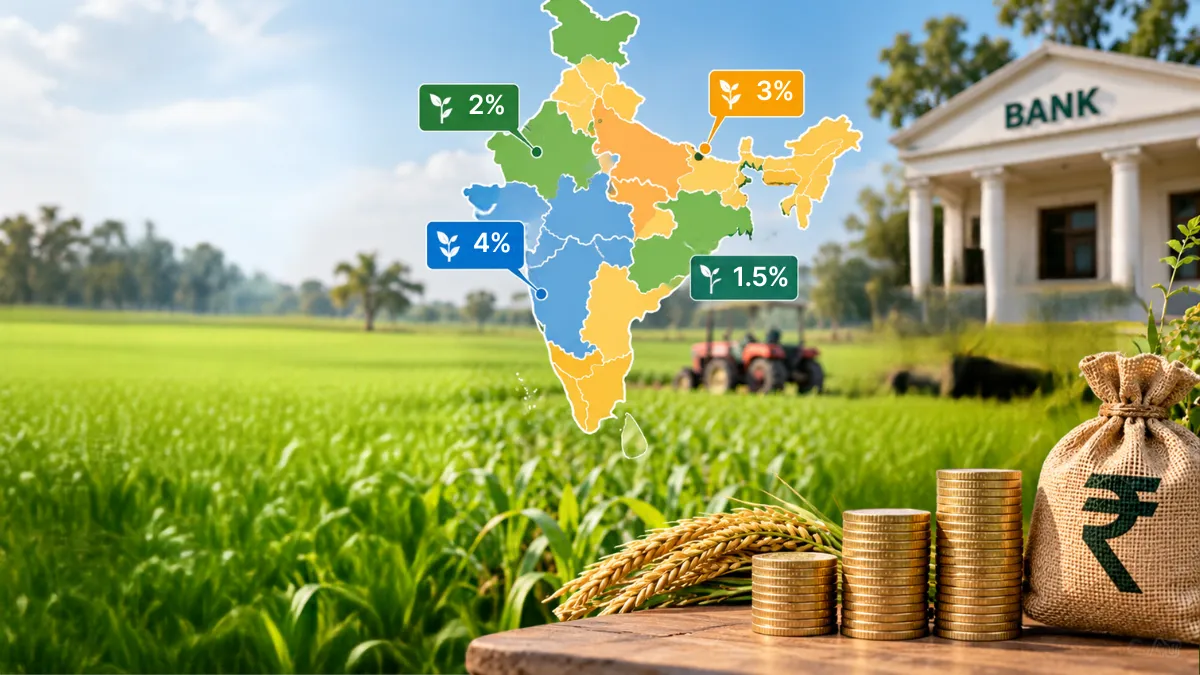
The interest payable on a Kisan Credit Card loan cannot be worked out from the state name alone. The loan purpose, lender, amount, repayment date and applicable government circular all matter. Two farmers in the same village may have different benefits because their loans come through different institutions or schemes.
Central interest support and additional state concessions must also be read separately. A zero-interest cooperative crop-loan programme does not automatically cover every KCC issued by a commercial bank.
How central KCC interest support works
In its statement dated 30 March 2026, the Ministry of Finance described short-term agricultural loans under the Modified Interest Subvention Scheme at 7%, with a 3% prompt-repayment incentive reducing the effective rate to 4% for eligible borrowers.
These percentages do not mean every amount sanctioned on a KCC attracts the concession. Ask the lender for the applicable financial-year circular, eligible loan component and subsidised ceiling. The total credit limit, the collateral-free limit and the interest-subsidy limit are different things.
The same Ministry statement reports a collateral-free agricultural loan limit of ₹2 lakh per borrower, effective from 1 January 2025. That collateral provision should not be mistaken for either a cash grant or the maximum possible KCC sanction.
State-wise position in the sources reviewed
The table gives verified examples and identifies remaining checks. It is not a claim that every state’s current concession has been fully verified.
| State | What the official source establishes | What the farmer must confirm |
|---|---|---|
| Madhya Pradesh | An official district-government notice confirms continuation of zero-interest short-term crop loans through cooperative banks for 2025–26 | The 2026–27 order, participating institution and crop-wise due date; the earlier order alone does not establish current eligibility |
| Rajasthan | The state’s 2026–27 Economic Review reports zero-interest short-term agricultural lending through cooperative institutions in 2025–26 | Current sanction terms, eligible limit and repayment conditions through the cooperative society or bank |
| Maharashtra | The Cooperation Department describes a 3% state rebate for eligible crop loans up to ₹3 lakh under the Dr. Panjabrao Deshmukh scheme | Applicable lender, full-repayment deadline and how central and state benefits are combined |
| Other states and Union Territories | Central support must be checked against the applicable loan and lending-year rules | Any additional state concession requires its own current order; no unverified state rate is quoted here |
A previous-year programme can be useful background, but it should not be used as proof that the same concession applies to a fresh loan today.
Maharashtra’s rule needs careful reading
The Maharashtra department’s scheme page describes full repayment before 30 June and an interest rebate of 3% on eligible crop loans up to ₹3 lakh. It states that qualifying borrowers can receive combined central and state benefits that make the covered crop loan interest-free.
Do not reproduce this as “all Maharashtra KCC loans are at 0%”. The institution, scheme coverage and repayment conditions still matter. Ask for the date applicable to your actual loan account, especially if a different seasonal due date appears in the sanction letter.
What timely repayment can mean in rupees
For a simple illustration, ₹1 lakh outstanding for a full year at 7% would generate ₹7,000 in interest. A qualifying three-percentage-point incentive would reduce the effective cost to ₹4,000, before any other applicable terms or charges.
Actual KCC accounts often have withdrawals and repayments during the year. Banks calculate charges from account activity and their applicable rules, so this example is not a repayment quotation.
Ask for an account statement showing the principal outstanding, interest charged and subsidy or incentive credited. If the credit has not appeared, ask whether it is pending processing or whether the account failed an eligibility condition.
Six questions to ask before using the loan
- What is my sanctioned limit and how much qualifies for interest support?
- Is this component a short-term crop loan or another type of credit?
- What is the repayment date for each drawal or crop season?
- Is there an additional state benefit through this particular lender?
- Is the incentive credited later or adjusted when I repay?
- What happens to interest and other charges if repayment is late?
Keep the answers with your sanction letter. A general advertisement should not replace the written terms of your account.
What if rain or crop loss affects repayment?
Inform the bank early and ask whether notified relief, restructuring or another applicable measure is available. Do not assume a loan waiver, an automatic deadline extension or continued prompt-repayment eligibility. Any relief must be supported by the relevant rules and applied to your account.