
Kharif MSP Rates 2026–27 and What Has Changed for Farmers
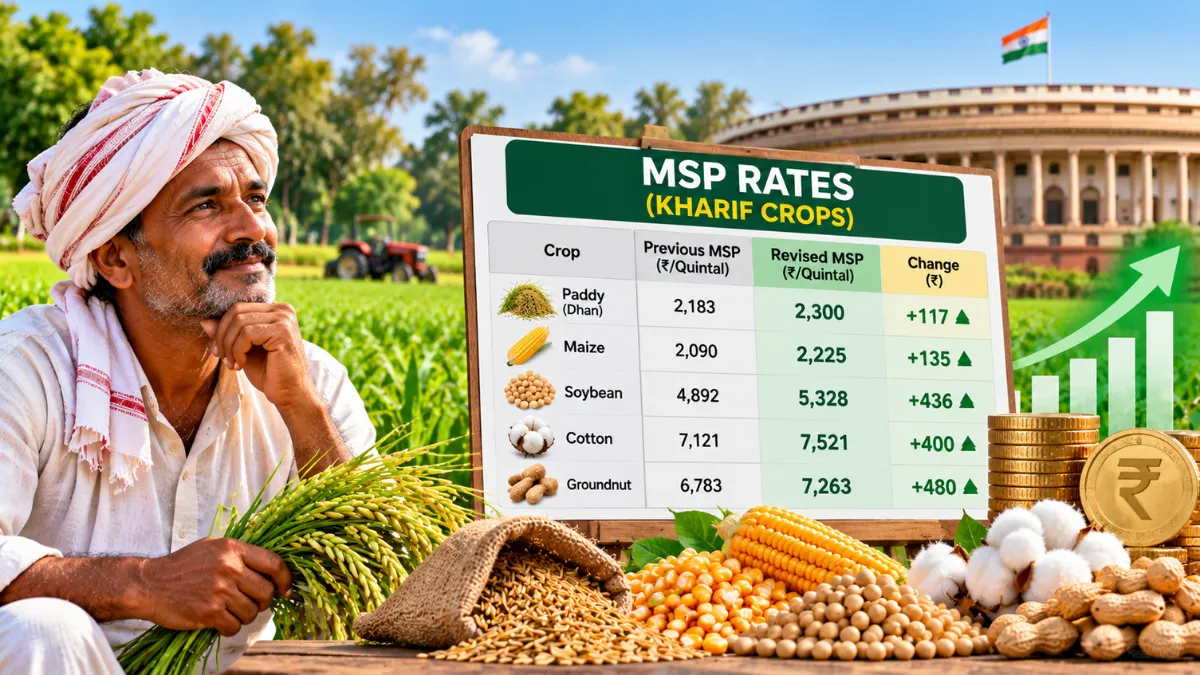
The government approved the Minimum Support Prices for 14 kharif crops for the 2026–27 marketing season on 13 May 2026. Farmers preparing to sell should use the new season’s rate for the correct crop and grade.
The complete comparison below includes separate grades where the government lists them. All prices are in rupees per quintal, and one quintal equals 100 kg.
Complete kharif MSP table for 2026–27
| Crop or grade | MSP 2025–26 | MSP 2026–27 | Increase |
|---|---|---|---|
| Paddy, common | ₹2,369 | ₹2,441 | ₹72 |
| Paddy, Grade A | ₹2,389 | ₹2,461 | ₹72 |
| Jowar, hybrid | ₹3,699 | ₹4,023 | ₹324 |
| Jowar, Maldandi | ₹3,749 | ₹4,073 | ₹324 |
| Bajra | ₹2,775 | ₹2,900 | ₹125 |
| Ragi | ₹4,886 | ₹5,205 | ₹319 |
| Maize | ₹2,400 | ₹2,410 | ₹10 |
| Tur/arhar | ₹8,000 | ₹8,450 | ₹450 |
| Moong | ₹8,768 | ₹8,780 | ₹12 |
| Urad | ₹7,800 | ₹8,200 | ₹400 |
| Groundnut | ₹7,263 | ₹7,517 | ₹254 |
| Sunflower seed | ₹7,721 | ₹8,343 | ₹622 |
| Soybean, yellow | ₹5,328 | ₹5,708 | ₹380 |
| Sesamum | ₹9,846 | ₹10,346 | ₹500 |
| Nigerseed | ₹9,537 | ₹10,052 | ₹515 |
| Cotton, medium staple | ₹7,710 | ₹8,267 | ₹557 |
| Cotton, long staple | ₹8,110 | ₹8,667 | ₹557 |
Source: Government of India’s 13 May 2026 announcement. There are 17 rows because some of the 14 crops have separately notified grades.
Which increases matter most for your farm?
The largest rupee increase is for sunflower seed. However, a ranking of increases is less useful than calculating the change for the crop you actually grow and the quantity you can sell.
For example, the ₹380-per-quintal increase in yellow soybean MSP would equal ₹7,600 on 20 quintals, if the entire quantity were sold at the respective MSP in both seasons. This is an arithmetic comparison, not a promised payment or profit forecast.
For common paddy, the ₹72 increase would equal ₹3,600 on 50 quintals under the same assumption. Your realised benefit can differ if output, quality, selling price or marketing costs change.
MSP and mandi price are different
MSP is the government-announced support price. A mandi quotation is the price being offered in a particular market for a particular lot. The two need not be equal.
The announcement does not establish that a procurement centre is buying every crop in every district on the day you arrive. Before transporting produce, check the responsible agency, operational centre, registration requirements, quality standards and purchase dates for your location.
Paddy procurement is explained separately by the Department of Food and Public Distribution. For other commodities, farmers need the relevant agency and state notices rather than assuming the paddy process applies to all crops.
Check these details before taking produce to a centre
Confirm the crop, grade and marketing season first. Then ask whether registration is open or already closed, whether an appointment is required and what records the centre needs.
Keep identity, bank and crop-related records ready as required by the applicable process. Check that the bank details match your registration. A spelling error or outdated account detail is easier to resolve before dispatch than after the produce reaches the centre.
Ask for the applicable quality specification. Dry and clean the crop appropriately, and obtain a reliable moisture check where required. Do not assume that a wet or mixed lot will be accepted at the headline rate.
Keep the weighment slip, acceptance receipt and payment reference. Compare the recorded crop and quantity with the material actually delivered before leaving.
Compare the amount left after selling costs
Suppose two lawful selling options are available. One offers a higher gross price but requires additional transport, handling or waiting. Calculate the amount left after those costs before choosing.
Use a simple comparison:
Net sale proceeds = accepted quantity × actual selling price − selling expenses.
Keep cultivation costs separately when calculating profit. A higher selling price does not mean higher profit if yield falls or input costs increase.
The government’s cost-based MSP calculation is a national policy calculation. It is not a measurement of the actual cultivation cost of each individual farm.
Should you change crops because MSP increased?
Use MSP as one part of next season’s planning. Also consider soil, water, suitable varieties, crop rotation, local buyers and the availability of procurement. A crop with a higher MSP per quintal may have a very different yield and cost structure.
Before moving a large area into an unfamiliar crop, discuss its suitability with the local KVK and check how farmers nearby market it. The ability to sell a quality crop matters alongside the announced price.