
Onion and Potato Export Rules and What They Mean for Indian Farmers
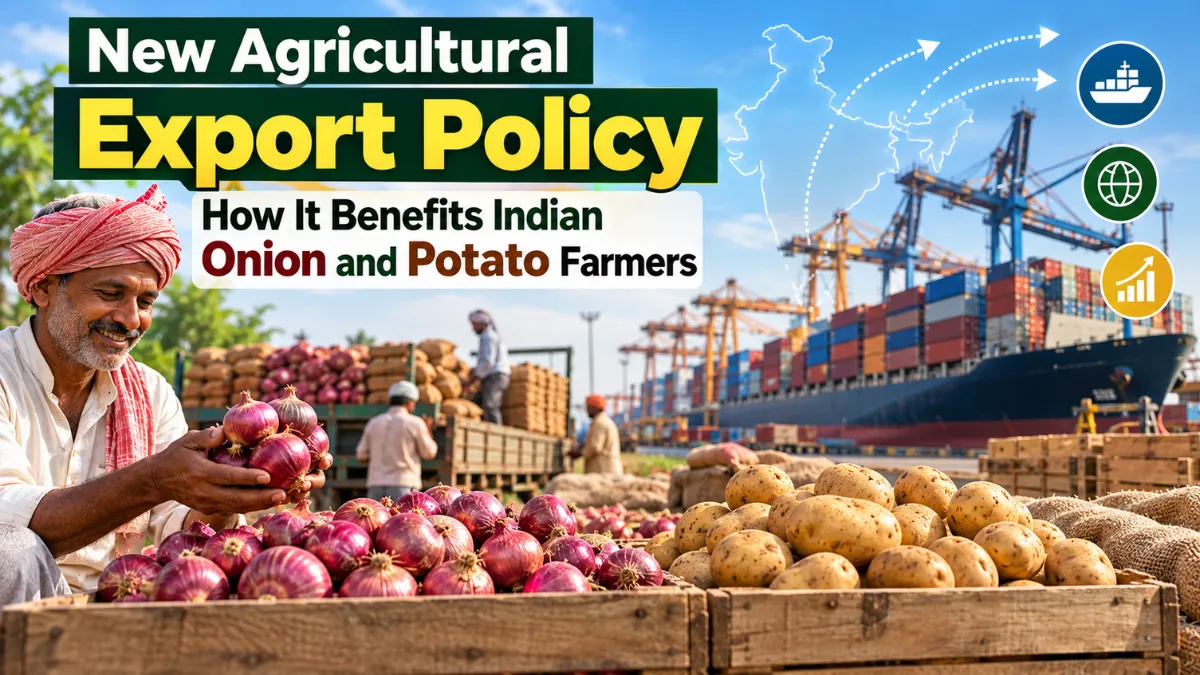
Export news matters to onion and potato farmers because overseas demand can influence the bids offered by traders. However, a policy headline alone does not tell you how much more a buyer will pay for your crop.
The verified onion decisions covered here were issued in September 2024 and March 2025, with the duty change taking effect in April 2025. They should not be described as a newly announced September 2026 agricultural export policy. Potato exports must be checked separately because an onion notification does not change the rules for potatoes.
Which onion export rules changed?
The Directorate General of Foreign Trade removed the minimum export price condition for onions covered by its notification dated 13 September 2024. The removed condition had required a minimum export price of US$550 per metric tonne.
The government subsequently announced the withdrawal of the 20% onion export duty from 1 April 2025. These were separate decisions: one concerned the minimum export price, while the other concerned export duty.
| Decision | Date | What it changed |
|---|---|---|
| Removal of onion minimum export price | 13 September 2024 | Removed the notified US$550-per-tonne pricing condition |
| Withdrawal of 20% onion export duty | Effective 1 April 2025 | Removed that duty on covered onion exports |
| Potato export classification | Product-specific export schedule | Must be checked independently of onion notifications |
These are the verified changes reviewed for this article. Exporters must check subsequent DGFT and customs notifications before booking a shipment; this historical timeline is not customs clearance advice.
What is the position for potato exports?
The DGFT export schedule published through APEDA lists potatoes under code 07019000, described as “Other”, with a “Free” export policy classification. This should not be extended automatically to seed potatoes, processed products or every possible product code.
“Free” is a trade-policy classification. It does not mean transport is free or that a consignment can enter another country without plant-health checks, documentation and buyer specifications.
Farmers supplying an exporter should first establish whether the buyer wants table potatoes, a processing variety or another specific grade. Producing a large quantity without a confirmed specification can leave the farmer with a crop that does not suit the intended market.
How easier exports may benefit farmers
Removing a pricing condition or duty can improve an exporter’s ability to compete overseas. If that leads to additional buying in producing markets, farmers may receive more competing bids. This is a possible market effect, not a guaranteed price increase.
The benefit depends on overseas orders, domestic arrivals, crop quality, freight charges and the exchange rate. A strong harvest can increase supply at the same time that export demand improves. Buyers may also reject lots that fail their size, condition or storage requirements.
For an onion grower in Maharashtra or Madhya Pradesh, the useful question is therefore practical: has the local buyer increased the net offer for this particular lot?
Compare the net offer, not the headline price
Suppose a local buyer offers ₹1,500 per quintal and another buyer offers ₹1,650, but the second sale requires ₹200 per quintal in additional grading, packing and transport. In this illustrative example, the second offer leaves ₹1,450 before other deductions.
These are example figures, not current mandi rates. Ask each buyer for the same information before comparing offers:
- Accepted grade and maximum rejection allowance.
- Whether payment is based on dispatch weight or destination weight.
- Who pays for bags, loading, transport and testing.
- When payment is due and which deductions are permitted.
- What happens if the buyer delays collection.
A written purchase agreement is particularly useful when farmers or an FPO aggregate produce for an unfamiliar buyer.
Should farmers store crops while waiting for export demand?
Avoid making the decision from a policy announcement alone. Calculate storage charges, likely weight loss, sorting losses and the cost of holding money in stock. Onion and potato storage requirements differ, so the same holding strategy will not suit both crops.
For potatoes already in cold storage, ask for a sample inspection before agreeing to a buyer’s quality conditions. For onions, check how much of the stored lot remains saleable rather than calculating potential revenue from the original stored weight.