
Neem Oil vs Chemical Insecticides: Cost, Effectiveness and Residues
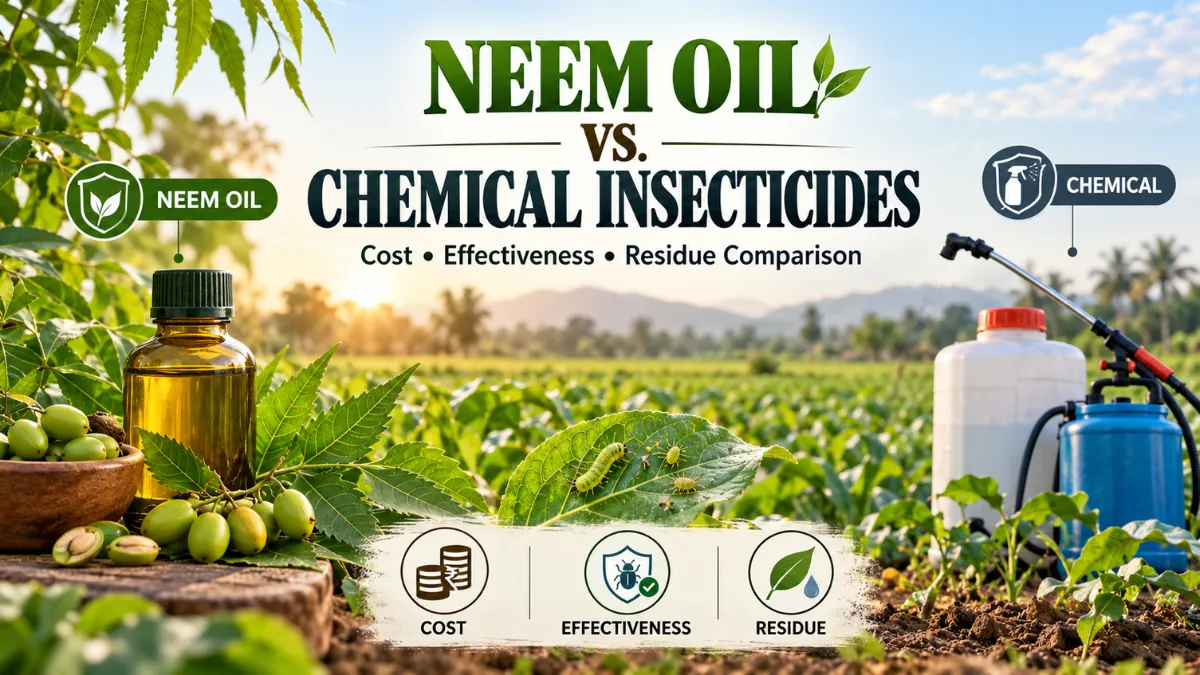
Neem oil may be useful in a vegetable pest-management programme, but it is not a direct substitute for every insecticide. A farmer dealing with a few young pests faces a different decision from someone seeing fast damage across the field.
The useful comparison is between two suitable treatments for the same crop and pest. Compare their expected control, total cost, harvest restrictions and effect on beneficial insects. Comparing only the bottle price can be misleading.
Neem Oil and Azadirachtin Are Not the Same Product
Neem oil comes from neem seeds and contains a mixture of substances. Azadirachtin is one important insect-active constituent. Commercial azadirachtin formulations may have a stated concentration, such as a ppm value.
Neem seed kernel extract, neem soap, neem seed pellets and formulated neem oil are also different preparations. Evidence for one preparation cannot automatically be applied to all the others.
Here, “chemical insecticides” means conventional synthetic insecticides. Neem also works through active chemical substances; natural origin describes the source, not the absence of biological activity.
How Does Their Action Differ?
Neem-derived compounds can discourage feeding and affect insect growth and development. Indian research on neem constituents has examined these feeding-deterrent and growth-regulating effects.
Synthetic insecticides have different modes of action. Some provide relatively quick control of susceptible pests, while others work differently. There is no single speed or level of safety shared by the entire category.
| Point | Neem-based treatment | Synthetic insecticide |
|---|---|---|
| Choice of product | Preparation and active concentration matter | Active ingredient and formulation matter |
| Visible response | May reduce feeding before obvious mortality | Speed depends on the insecticide and pest |
| Severe attack | May be insufficient in some situations | A suitable product may provide stronger control |
| Repeat application | Follow label and field need | Follow label, limits and resistance guidance |
| Residue judgement | Not automatically residue-free | Not automatically non-compliant when used correctly |
| Harvest timing | Follow the specific product instructions | Follow the crop-specific waiting period |
Neither column removes the need to identify the pest and check the current approved use.
What Indian Work Tells Us
ICAR-IIHR has developed neem-based preparations for vegetable pest management. An ICAR field report describes use of its neem seed powder pellet formulation in cabbage and cauliflower.
This is evidence about that preparation and field experience. It is not proof that a bottle of unstandardised neem oil will give the same result. Similarly, a laboratory result showing reduced caterpillar feeding does not establish the exact saving a farmer will get per acre.
ICAR's vegetable research also includes programmes combining botanical, microbial and need-based synthetic options. The practical aim is suitable control with fewer unnecessary treatments, rather than choosing one category for every situation.
Compare the Cost of the Complete Job
For each suitable option, calculate:
Treatment cost per acre = product used per acre + labour + water/pumping + equipment or service charge.
Then account for the number of applications actually required within the label directions. The following is an arithmetic example only, not a market-price or spray-frequency recommendation.
| Assumed cost | Option A | Option B |
|---|---|---|
| Product cost per application | ₹250 | ₹450 |
| Labour and other application cost | ₹300 | ₹300 |
| Total for one application | ₹550 | ₹750 |
| Total if two applications are needed | ₹1,100 | ₹1,500 |
The cheaper option per application may cost more over the whole control period if it needs an additional permitted treatment. Equally, a higher-priced product may not be worth paying for if a suitable lower-cost treatment provides adequate control.
Use your local quotations and actual label rate. Do not assume that neem always needs two sprays or that a synthetic product always needs only one.
Which Has the Lower Residue Risk?
Residue risk depends on the exact product, crop, dose, number of applications and time before harvest. It cannot be decided from the words “natural” and “chemical” alone.
Do not advertise a harvested crop as residue-free merely because neem was used. A claim about residues needs appropriate evidence, and other treatments or drift may also matter.
For either option, keep spray records and follow harvest instructions. FSSAI guidance on washing explains reduction of some residues; washing does not replace correct application or the required waiting period.
A Practical Way to Choose
First identify the pest and check whether treatment is needed. If a suitable neem-based product can manage the situation, use it according to its directions and monitor the result.
If damage is increasing and a stronger intervention is needed, select an approved treatment with local agricultural advice. Account for the upcoming harvest and protect pollinators and other useful insects.
Avoid homemade tank mixtures of oil, detergent and insecticides. Compatibility, crop injury and dose cannot be judged just because the mixture appears to blend in the tank.